Another Baseless Conspiracy Theory: The Artemis II Mission Was Faked.
By Samantha Rubin and Oisakhose Aghomo
Reporting Texas
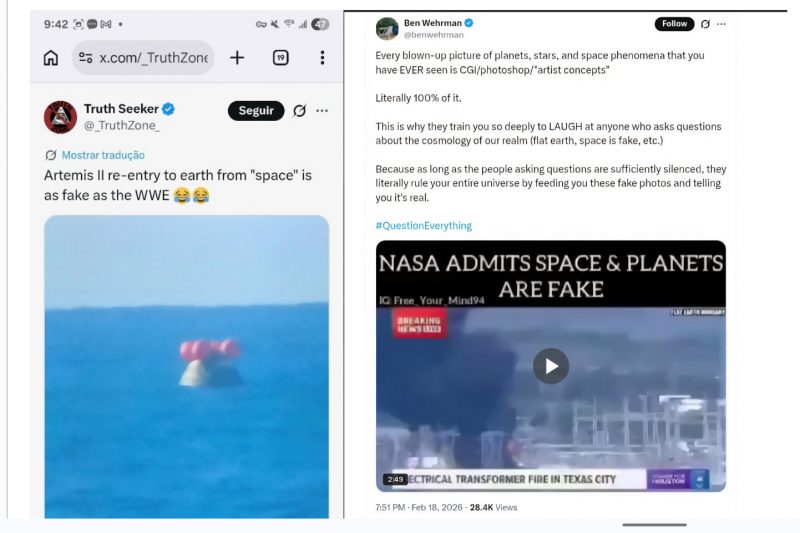
Screen shots of hoax tweets showed up on social media. Reporting Texas
As NASA prepares for more missions like Artemis ll, public interest in space has spiked again. But alongside the excitement is an uptick in skepticism doubting NASA’s achievements in online conversations.
“Anything that has that level of attention… makes itself ripe for conspiracies,” said Asheley Landrum, an Arizona State University journalism and mass communications professor.
X, formerly known as Twitter, has been a hotbed for conspiracy theorists saying that the Artemis II was fake — with some users accusing NASA of an elaborate ruse using computer graphics and AI-generated photos.
Doubts about America’s achievements in space are nothing new. Skepticism surrounding the Apollo missions began shortly after astronauts first landed on the Moon, and decades later polls still show that a small percentage of Americans believe the moon landings were staged.
 Experts say these “space is fake” groups continue to exist due to institutional distrust and the impact of social connections.
“It’s easier to accept that the government is misleading us than it is to believe we sent humans to the moon,” said Gale Sinatra, a University of Southern California professor of education and psychology.
Sinatra said that the lack of trust in institutions started from “bad actors.”
“The government has lied to us before they lied to us about weapons of master destruction and Iraq,” she said. “They lied to us about how the Vietnam War was going. They lied to us about lots of stuff. There’s lots of evidence that the government has misled the public…so they could be misleading us now, right?”
Landrum said it’s important to make a distinction between the types of thinking that people within conspiracy-minded groups exhibit.
“I say that conspiracy theorizing is something that happens in cases of motivated reasoning,” Landrum said.
Motivated reasoning helps individuals resolve internal conflicts when new information clashes with existing beliefs.
“The conspiracy theories that are being concocted or cobbled together are doing so to justify not doing or disbelieving or distrusting information that you don’t want to believe because of the source that it’s coming from,” she said.
Landrum believes that conspiracy mentality is “a personality trait” of people who are suspicious of authority figures and institutions with power.
“There’s actually a very small number of people who have that real deep distrust conspiracy mentality, but a large number of people will conspiracy theorize when it suits them to try to resolve cognitive dissonance, ” Landrum said.
Media’s complicated relationship with conspiracy
The media ecosystem plays a complex role in shaping how these ideas circulate. These days most of the conspiracy theory communities congregate on social media and online platforms.
But contrary to popular belief, some experts say social media may not be that powerful in creating conspiracy theories.
“I mean, if you compare the web traffic for The New York Times to Alex Jones, who’s the biggest conspiracy website, it’s not even close,” said Joseph Uscinski, a University of Miami professor and author of “American Conspiracy Theories.”
Uscinski said that Americans go to social media or to the internet “for all sorts of things, but news of any kind is not necessarily the number one thing.”
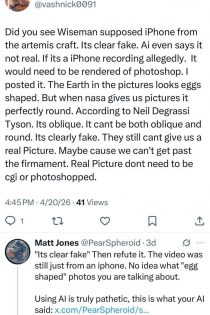 Instead, entertainment media may play a larger role in shaping how people imagine space in the first place.
“For many people, what they know about space after school comes from science fiction,” Landrum said.
That exposure can blur the line between scientific reality and imaginative storytelling, influencing how audiences interpret real-world discoveries.
“There’s things that go against your sensory experiences and those are ones that are challenging for people. It’s just difficult to believe we did that,” Sinatra said.
Major missions like the recent Artemis ll draw global focus, increased funding and government involvement are all factors that can trigger suspicion among some audiences.
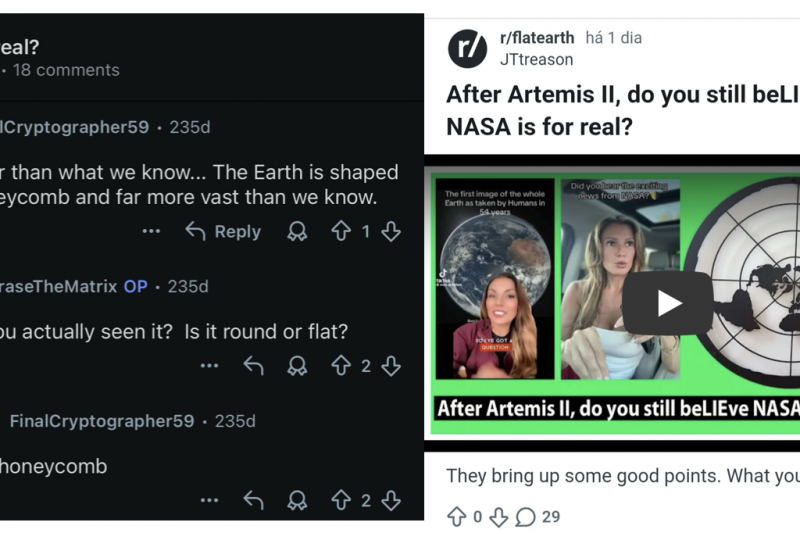 It’s a culture and a lifestyle
For conspiracy theorists, it might be more about the friends they made along the way than the theory itself, Sinatra said.
The theories led to groups which offer a sense of identity and belonging, Sinatra said, allowing people to feel like they are “in on” information the out-group doesn’t have.
Once those beliefs become tied to identity, they are difficult to change.
“People don’t want to change their minds,” Sinatra said. ” Because it means changing who they are.”
“I think Marjorie Taylor Greene, for example, was a Q-anon kind of believer. Then, she was all in on releasing the Epstein files and President Trump never did it and she left the fold over it. So she’s an example of somebody who did change,” Sinatra said.
This had consequences as Sinatra noted that Greene’s “whole group and her whole identity had to shift.”
Despite advances in technology, access to information and scientific transparency, conspiracy theories about space are unlikely to disappear anytime soon.
“There’s all sorts of nonsense that people believe all the time,” Ucinski said. “People come to beliefs first, and then maybe gather evidence.”
As humanity pushes further into space, experts say the challenge for journalists and scientists will be not only explaining discoveries, but bridging the gap between what is known and what feels believable.