Science Fare: How Teachers Are Using the Artemis II Mission to Build STEM Excitement
By Max Mazoch
Photography By Max Mazoch
Reporting Texas
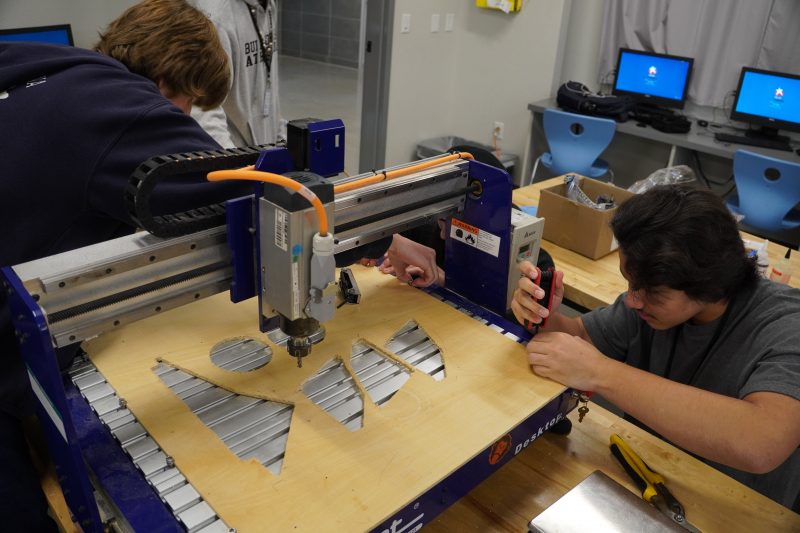
Johnson High School rocketry students use a table saw to cut rocket fins for a class project. Max Mazoch/Reporting Texas
While Artemis II will be remembered for its accomplishments beyond our planet’s atmosphere, one of the most important breakthroughs happened back on Earth.
Artemis II — whose crew travelled a record breaking 250,000 miles away from Earth — captured the minds of millions across the globe, inspiring curiosity in people of all ages. In a Buda elementary school, teachers used the event to spark students’ interest in space and technology.
“We start all of our units with things that will get them excited,” said Shelley McDaid, a Cullen Elementary School teacher. “We get to know who they are personally and figure out what makes them tick and interested in and try to play into that.”
McDaid and fellow first-grade teachers Valerie Villegas and Megan Westphal aim to create lesson plans that help students connect “what they’re learning to the outside world and real-life examples,” Villegas said.
The Artemis II mission “fit perfectly” into their lesson plans as a way to teach through an “important” world event, Villegas and McDaid said.
In March, during the buildup to the launch, the three used the mission’s astronauts to teach their students about biographies. The classes learned how astronauts needed to excel in math and science and made trading cards with each student’s favorite crew members.
“I feel like Christina Koch got the girls really excited about it,” McDaid said of the astronaut who served as mission specialist on Artemis II
“It opened their eyes to different careers too,” Westphal said. “This is what it takes to be an astronaut. I can do that, too.”
The teachers said their students’ excitement carried through the launch on April 1.
“We were streaming the launch and NASA kept showing the astronauts getting ready,” Villegas said. “They were like, ‘There’s Reed. There’s Christina.’ ”
Students’ interest in STEM is tied to their identity and being able to see themselves in the field, said Carrie Allen, a University of North Texas learning sciences professor specializing in K-12 STEM engagement.
Artemis II’s social media presence showed “all the different representations of the different people” who made the mission possible, Allen said, allowing students to visualize where they could see themselves fit.
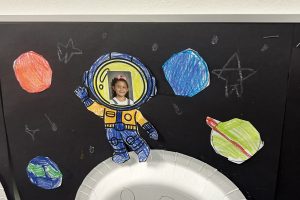
First grade teachers at Carpenter Hill Elementary use Artemis II-themed projects to inspire students. Photo Credit: Harvest Goodrich, Hays CISD
Students also learn well when their learning experiences are “meaningful and relevant,” Allen said, where students can connect knowledge they gain to “real issues” and their own “lived experiences.”
Jeremiah Thomas, a finfth-grade science and social studies teacher at Carpenter Hill, said he related how rock samples taken from the moon in previous missions were similar to his students’ own exploration of topics like the periodic table.
“Every time we’re in a science lab, we’re trying to make discoveries,” Thomas said. “That’s the same with the astronauts.”
Artemis II also showed the teamwork needed to create scientific breakthroughs.
Students are more drawn to STEM as a possible career when they learn the field is collaborative, Allen said. Students learn best through social interactions and are more engaged when their studies contribute to a purpose bigger than themselves.
“(The launch) can offer an opportunity to mirror back something about humanity, about connectedness, about the different ways that people can come together and collaborate,” Allen said.
This sense of connectedness and collaboration can be seen in Bryant Griessel’s rocketry class at Buda’s Johnson High School.
Among the buzzing sounds of drills in a third-floor lab room, students from multiple grade levels can be seen working together to create rockets.
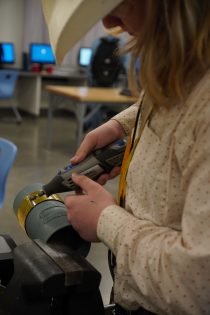
High school student Logan Semack uses a dremel rotary tool to work on the rocket’s electronics bay. Max Mazzoch/Reporting Texas
The class is divided by the projects students are working on. Juniors are working to launch a rocket a mile into the air, while sophomores have worked to build rockets that could launch confetti eggs and deliver them back to the ground safely.
Teamwork and real-world scenarios are key parts of their projects, Griessel said.
“They had to come up with a theme for their team,” Griessel said. “They acted like they were companies, and I was the person that wanted to take the contract of the best company that had the best design for the egg rocket pillow.”
While there’s a wide spread of engineering interests in the class, Griessel said, the Artemis II launch helped tie the class together and inspire deeper interest in their current projects.
The variety of interests also benefits the projects as students can embrace their specialties and help teach their classmates, and even himself, Griessel said.
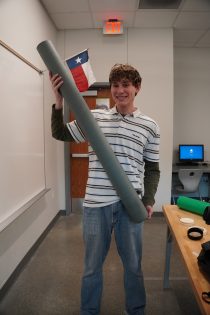
Senior Ayden Jenray poses with the bottom third of a rocket. Max Mazoch/Reporting Texas
This can be seen throughout the classroom as some students use mathematics computer programs to simulate the distance their rocket is expected to travel, while others focus on building the physical parts of the design.
Ayden Jenray, a senior who focuses on building the body for the rocket, said he became “hooked” on building rockets after visiting NASA when he was a kid.
Jenray will attend Texas A&M University’s engineering program in the fall and hopes to get a job with NASA after he graduates.
He said the Artemis II launch makes him hopeful.
“I’ve been watching the live, whole mission,” Jenray said. “It kind of just excites me for the future and what we’re able to accomplish.”