As Commercial Space Industry Soars, Experts Worry Regulation Is Sliding Backward
By OISAKHOSE AGHOMO
Reporting Texas
It’s the 21st century space boom, and the private sector has the stars in its sights. Yet experts caution that the Trump administration’s fondness for deregulation and institutional shakeup puts the commercial space industry on route to an unsustainable future.
“I am a person that believes that we need some regulation, but we need to make sure that we revisit them very regularly,” said Diane Howard, who served as director of commercial space policy for the National Space Council within the Biden White House. “That said, we are not in an environment anymore in the U.S that likes any regulation at all.”
Space is already littered with geopolitical intrigue and debris – more than 25,000 objects worth, according to NASA. The international community has been concerned about congestion in Earth’s orbit as it increases the potential for collisions and inability to use space-based tech. As more U.S. companies jump to get in the market, policy makers are trying to facilitate easy entry — but some warn that such deregulation has risks.
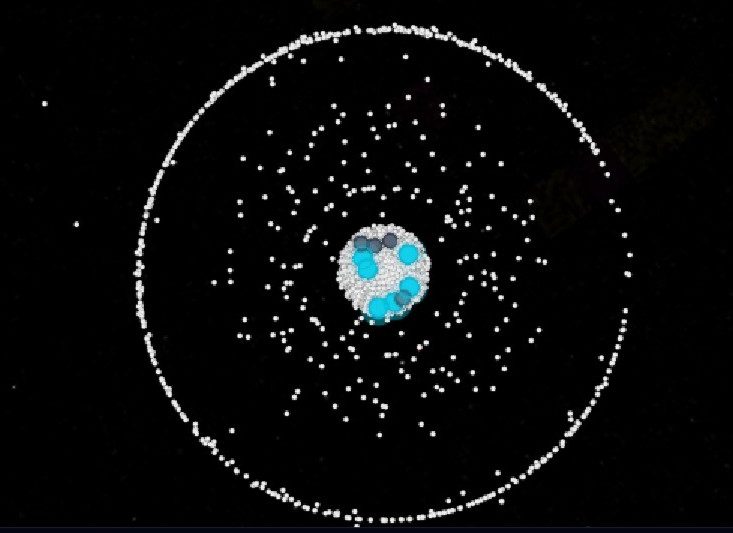
A screenshot from Track the Sky, which pulls data on satellites from CelesTrak, shows spacecrafts in orbit.
It’s Getting Crowded Up There
The U.N. Office for Outer Space Affairs said that 3,708 objects were launched into space from the United States in 2025, compared with 984 in 2020.
The laws and regulations about getting things off the planet can be baffling to outsiders, but the most important thing to know is that licensing is the main way the government regulates space companies.
Licensing processes are handled by the Federal Aviation Administration, the Federal Communications Commission and the National Oceanic and Atmospheric Administration.
Licenses for space launches, reentries and space operations include protections that decrease the possibility of collisions, explosions and debris.
Some were already concerned that penalties for breaking the rules were too small to deter multimillion-dollar corporations like Space X.
In 2024, the FAA proposed $633,009 in civil penalties against SpaceX for using “an unapproved launch control room” and using “an unapproved rocket propellant farm.”
Howard said the financial penalties were ” like a slap, but at least they did something.”
In 2025, SpaceX owner Elon Musk took a DOGE-sized axe to the FAA, RollingStone Magazine reported.
Reporting Texas contacted SpaceX for comment about its compliance methods but received no response.
NASA, under a policy begun in the 1990s, mandates that spacecrafts in low earth orbit must deorbit within 25 years after launch. This has widely been seen as the standard among the international community. In 2022, during the Biden administration, the FCC updated the guideline into a five-year rule for the private sector.
Darren McKnight, senior technical fellow for LeoLabs, a key voice cited in this process, wanted more.
“It shouldn’t be a 25-year rule. Shouldn’t be a five-year rule. Should be a five-day rule,” McKnight said. “There’s no reason why you should leave things up there. … You should not leave it there and pose a risk to other people. That’s irresponsible.”
Now, he worries about regression.
“Fast forward to the current administration. Words like ‘inclusion,’ ‘environment,’ ‘sustainability’ have been crossed off of their vocabulary,” McKnight said. “This is the bane of my existence that all the inroads we made to improve over the last six years have all been completely stomped out by removing those words from laws, from actions, from executive orders, from websites.”
Brendan Carr, the FCC chairman in the second Trump administration, spoke out in 2024 against the Biden administration as promoting “DEI requirements,” as well as “a climate agenda” and accused the administration of “regulatory overreach” in its policies on internet connectivity.
Under Carr the agency launched the “Delete, Delete, Delete” campaign seeking “public input on identifying FCC rules for the purpose of alleviating unnecessary regulatory burdens.”
NOAA, which oversees licenses for commercial Earth remote sensing satellites, also conducts critical research on space debris. On April 13, The Hill reported that NOAA is in limbo for grant funding.
“They (NOAA) were doing a study at the end of 2024 (on chemical space debris),” Howard said. “But a lot of money for research has been pulled, so that’s an issue. Anything that’s kind of on the cusp of, ‘are we talking about the environment?’ Oops.”
Trump Administration Loosens Regulations
Trump has signed several executive orders to loosen regulations on the commercial sector. One executive order, known as “Enabling Competition in the Commercial Space Industry,” allows the Department of Transportation to sidestep environmental impact reviews through unprecedented loopholes. Experts worry that the FAA will stop considering environmental effects when approving commercial space licenses.
On the legislative side, Sen. Ted Cruz, R-Texas, and Sen. Peter Welch, D-Vermont, proposed the Satellite and Telecommunications Streamlining Act in January to revamp the FCC application process and “remove regulatory barriers and uncertainty that could threaten investments in the United States’ commercial satellite industry.”
Sharon Strover, co-director at Technology and Information Policy Institute at UT-Austin, said she suspects sponsors of the act want to enable telecommunications companies to invest in more rural connectivity. That could lead to more communications satellites in orbit.
“I see it as putting the FCC on a schedule here, in order to facilitate more market access,” Strover said. “I guess the question that raises is, does that mean the FCC would have to cut some corners in order to comply?”
Reporting Texas contacted the policy’s sponsors and the FCC for comment on the SAT Act but received no response.
While the U.S. government pushes for less regulation, the European Union last year announced its own Space Act to “boost competitiveness within the European space sector” and enact “ robust rules for tracking space objects and mitigating space debris.”
Non-EU companies that don’t comply risk being shut off from EU markets.
“I’m hoping that the proposed European Union Space Act is a wake-up call for them… if the U.S. doesn’t put its own stuff in place, then those U.S. (private) operators could be subject to much stricter EU regulation. They have no trouble getting strict,” Howard said.