As Austinites Mourn South Congress’ Lost Identity, Businesses Prove ‘There’s Life Beyond It’
By Rachel N. Madison
Reporting Texas
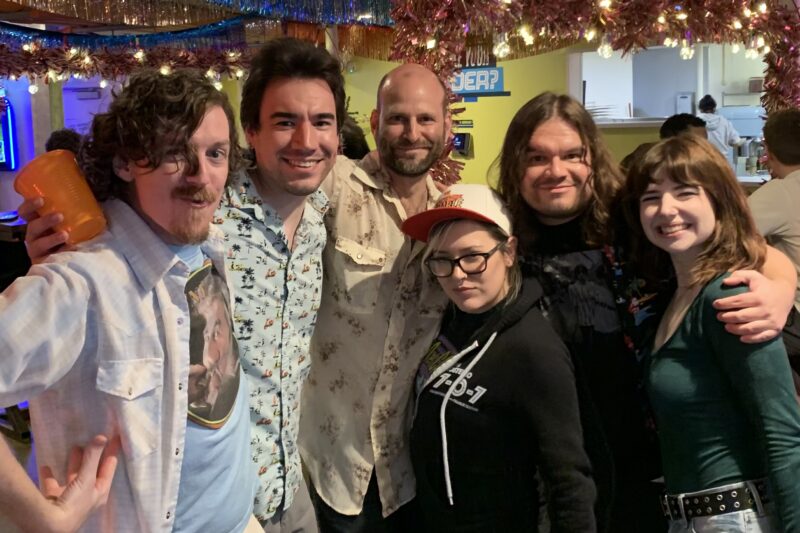
Monkey See Monkey Do staffers made the move off of South Congress. Left to right: Benjamin Akers, Richie Garza, Brandon Hodge, Taylor Norwood, Steven Almaguer , and Sarah Wallace. Dec 2024. Photo Credit: Benjamin Akers
From its origins as a connective Central Texas strip to bustling retail hub to the site of countless indie films, South Congress Avenue has long been one of Austin’s iconic spots.
But the street’s fame is taking a toll.
Around a dozen of the street’s legacy businesses have relocated or closed their doors entirely over the past five years as a result of rising rents and redevelopment, replaced with luxury shops and retail chains as the strip evolved from the city’s quirky small-business hub into a corporate retail district catering to tourists and Austin’s growing upper class.
Name brands like Hermès, Kendra Scott, Alo Yoga and Tecovas have come to dominate the once eclectic and local atmosphere.
While many legacy businesses had to shut their doors, owners who decided to relocate from South Congress say it might be the best decision they ever made.
“Last year was our best year ever in any location,” said Daniel Schmitt, the manager of Uncommon Objects. “We lost our tourist traffic, but gained back our designer and film traffic that weren’t going to SoCo anymore because it was so crowded.”
Instead of wrangling window-shopping tourists, the store can now focus on catering to its committed customers in its new storefront off Ben White Boulevard and Menchaca Road, which it opened in 2017.
Monkey See’s new location at Menchaca and South Lamar. Rachel N. Madison/Reporting Texas
Steven Almaguer, the general manager of toy and gift shop Monkey See, Monkey Do!, echoed his message, saying that the shop is “thriving” since relocating to its Menchaca location last year. He hopes to pass on that message of hope to other small businesses who may be struggling.
The commercial shift is largely inevitable on a retail strip in a city like Austin where larger cultural changes are already at play, and it isn’t likely to stop soon, explained Jake Wegmann, a University of Texas professor of urban planning.
“SoCo is one of the nation’s iconic retail strips,” he said. “Once it has that status, all the sudden, other luxury brands want to be there.”
It’s an example of what experts call an agglomeration economy, where luxury retailers cluster together in an established destination that then motivates other businesses to move in to capitalize on the existing market.
This causes an economic feedback loop that can make it nearly impossible for a small business to compete, “even if it adds charm and character and embodies Austin’s quirky ethos,” Wegmann said.
This was the case for Uncommon Objects, which saw its rent rise by 500% after its building was sold to an out-of-state developer in the mid-2010s, Schmitt said.
The news came after over a quarter century on the Congress strip.
Monkey See, Monkey Do!’s rent nearly doubled over the span of a decade, which drew from its sales and triggered its move just two months after its 20th anniversary, Almaguer said.
Loyal returning customers now help the store retain and improve its sales, which “wasn’t the case with South Congress,” he said. “We saw dozens more people a day, but fewer reliable customers.”
Some businesses went a step further by deciding to close their brick-and-mortar stores altogether to save money. Tesoros Trading Company shifted its business to a virtual wholesale market after closing its South Congress location in 2022 after 33 years on the street.
“We got a five-year notice that they were redeveloping the land for a hotel,” said co-owner Kisla Jimenez, whose husband opened the store in the late 1980s.
Jimenez said that they don’t regret retiring from traditional retail and that their wholesale customer base allows them to stay in business and retain their focus on quality vendors and products.
It was a question of, “how much longer do we want to be open to justify such a big expense,” she said. “It was time”
In a world of competition and rising costs, Wegmann said businesses’ best bet at survival is to adapt.
“If they do business the same way they did in 2006, they might not make it,” he said. “People may stop in, but they won’t buy anything. Meanwhile, insurance and property tax, utilities, and rent have gone up, not to mention landlords are tempted by other products with higher payoffs for higher rent.”
This may, however, be easier said than done. While some businesses can adjust to host more luxury brands to cater to new shoppers, thrift stores, for example, can’t increase profit margins or change vendors because of their very nature as thrift retailers, he said.
For those that cannot change inventory, owners believe relocation may be the key to survival.
“I don’t know anyone that moved off SoCo wholly electively,” Schmitt said. “It’s not a choice, but it doesn’t have to be the end. I’m so happy with our move and the way we’ve been able to operate. I think a lot of it is better.”
Almaguer encouraged other small businesses to see moving as an opportunity rather than a defeat.
“We are proof that it can happen and be successful, and that there is definitely life beyond it.”