Weather Models, Poised for a Technological Boost, Face a Stormy Funding Outlook
By AJ Muonagolu
Reporting Texas
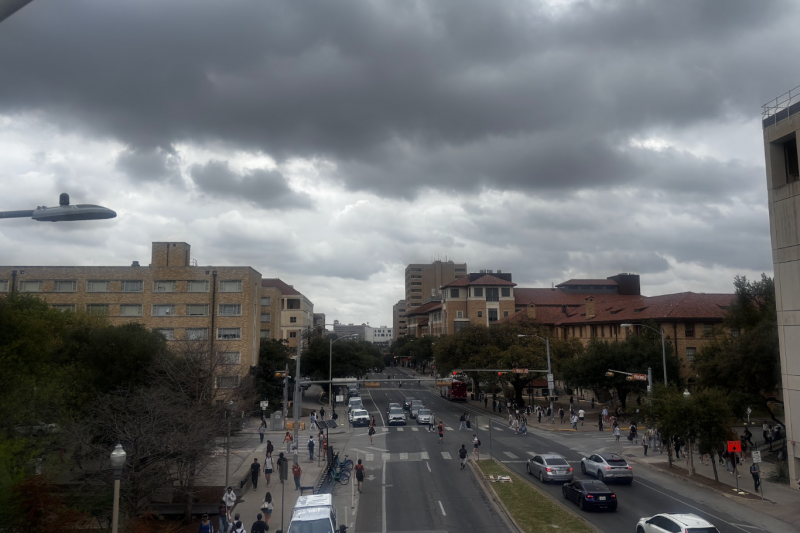
Weather researchers say that federal funding decisions impair their work as they develop improved forecasting methods. AJ Muonagolu/Reporting Texas
Do April showers really lead to May flowers, and can a groundhog accurately predict the length of winter better than a meteorologist?
With new technology like artificial intelligence and larger pools of historical and current data, weather models and forecasting are continuing to improve. However, with recent budget cuts and gaps in funding from the Trump administration, experts worry whether forecasting could decline. And the wild card is artificial intelligence.
“Artificial intelligence is actually involving itself more and more in weather forecasting,” Austin meteorologist Troy Kimmel said. “AI is wanting to get involved in all of it so it’s going to be interesting to see how that unfolds.”
Current weather technology focuses on computerized models and radar supported by satellite data. Most of today’s forecasting models began in the 1940s to early 1960s. Radar and computerized models help interpret and showcase data extracted through low earth orbit satellites.
In December, the National Oceanic and Atmospheric Administration launched three new AI weather models that the agency hopes will help improve accuracy, give faster forecasting and reduce operational costs.
AI helping in weather forecasting isn’t new, though the government’s use of it is. Google began enhancing its weather forecasting with AI in late 2023 and introduced an updated model in 2024 called GenCast.
“We’re talking about the U.S. government, and I mentioned that not to degrade them, but to say that the government is slow moving in what it does,” Kimmel said. “They’re not quickly evolving sometimes, but on the other hand they really done a pretty amazing job keeping up with the modeling.”
The U.S. government generally uses two types of models for forecasting: Global models like the Global ForecastSystem are long range, and the High Resolution Rapid Refresh model is short range.
Though experts say AI isn’t quite on par with current computer models, it is learning from historical weather data to create more accurate and efficient forecasting.
Being able to know the general weather forecast is only one part of the equation.
For weather forecasts in Texas, you tune into your local news station or check a privately owned weather app that is interpreted by other meteorologists based on data from the National Weather Service. Some states have launched their own state-owned weather apps and websites.
Texas Mesonet — or TexMesonet — is supported by the Water Development Board and uses the NWS to create forecasts that are publicly available on a state-run website.
Oklahoma, home to the National Weather Center, has gone the next step and launched its own weather forecasting app, Oklahoma’s Mesonet app, and made it available to the public. New York and Kentucky also have public weather apps.
Texas may not be far behind. The Texas Water Development Board sent a proposal to the state to create a Texas weather app.
“It’s not just collecting data, but delivering the data in a useful fashion to people,” Texas State Climatologist John Nielsen-Gammon said.
With the approval process and the designing the framework for a state-run app, Neilsen-Gammon said the state software could take at least a year before it will be ready to use.
To fund the app would require asking for more funding to the Texas Water Development Board and then “the next legislative session they would be requesting that these new initiatives be funded and that’ll be up to the legislature rather to allocate the money,” Nielsen-Gammon said.
The funding may be the hardest part.
“For example, Southern Regional Climate Center that I run had a gap in funding last year, unfortunately just a few days long because of contracts having to go through many additional approval steps and that means there was a loss (in work),” Nielsen-Gammon said.
The Trump administration has recently delayed funding to the NOAA Argo program and other grants that research climate and weather patterns. The Argo program is an international program that uses balloon-like floats that free drift in the ocean to collect information on ocean patterns to help predict possible storms and other climate indicators.
“I heard talk of potentially the United States pulling out of the Argo program. So that would leave us with less ocean data in the future if that were to take place. So that’s a potential threat,” Neilsen-Gammon said.
Even with current or potential holds in funding weather forecasting is still considered robust and accurate, thanks to the current levels of technology and better trained interpretation, Kimmel said.
“Mother Nature has a very good way of putting me in my place sometimes,” Kimmel said. “Weather forecasting is an imperfect science, I’d say three to four days and our accuracy rates are probably between 85 and 90 – and I don’t know about you, but if I’m taking that test and I’m making 90 on it, I’m happy with that.”