Federal Judge Allows Protesters Lawsuit Against UT to Proceed on First Amendment Claims
By Destiny Lewis
Reporting Texas
A federal judge has allowed key First Amendment claims to move forward in a lawsuit filed by University of Texas at Austin students who were arrested and disciplined after participating in a pro-Palestine protest on campus in April 2024.
The lawsuit, filed by the American-Arab Anti-Discrimination Committee in April 2025, alleges that UT-Austin officials and state leaders coordinated efforts to suppress pro-Palestinian speech through mass arrests, physical force and retaliatory disciplinary actions, in violation of the students’ constitutional rights. Defendants include UT-Austin, Texas Gov. Greg Abbott, former UT-Austin President Jay Hartzell, current President Jim Davis and officers with the UT Police Department and Texas Department of Public Safety.
U.S. District Judge David Alan Ezra partially denied the defendants’ motion to dismiss the case, allowing the students’ core claims of viewpoint discrimination and retaliation to proceed toward trial.
“What the judge is saying is that there could be facts out there that would allow the plaintiffs to win, so the case needs to move forward to determine what actually happened,” said Steven T. Collis, a clinical professor and director of the Bech-Loughlin First Amendment Center at UT. “It doesn’t tell you who will win — it just means the court is going to examine the facts.”
The protesters allege they were demonstrating peacefully on April 24, 2024, when law enforcement officers arrested students without probable cause and used aggressive crowd-control tactics. According to the complaint, officers tackled protesters, zip-tied students tightly enough to cause injury and forcibly removed a Muslim student’s hijab. Criminal charges against the protesters were later dropped, but students say UT administrators imposed disciplinary penalties, including academic holds and suspensions.
Body camera footage released by the plaintiffs’ attorneys includes audio of officers questioning the legality of the arrests before they were carried out. In the 37-second edited clip, one officer asks, “We’ve been asking this question, but now what are they doing illegal? … We do this after the Aggie games?” Another officer responds, “No,” while others express uncertainty over which protesters they are supposed to arrest.
Attorneys for the students say the footage shows officers were aware the protesters were not breaking the law but proceeded anyway. In a joint statement, legal teams from ADC, Muslim Legal Fund of America, Webber Law and Project TAHA said the audio “makes clear what our clients have said all along — these arrests were politically motivated and executed with full awareness that no laws were broken.”
The court also allowed claims against Abbott to proceed, citing allegations that state troopers acted “at the direction” of the governor. Plaintiffs point to public statements Abbott made as arrests were underway.
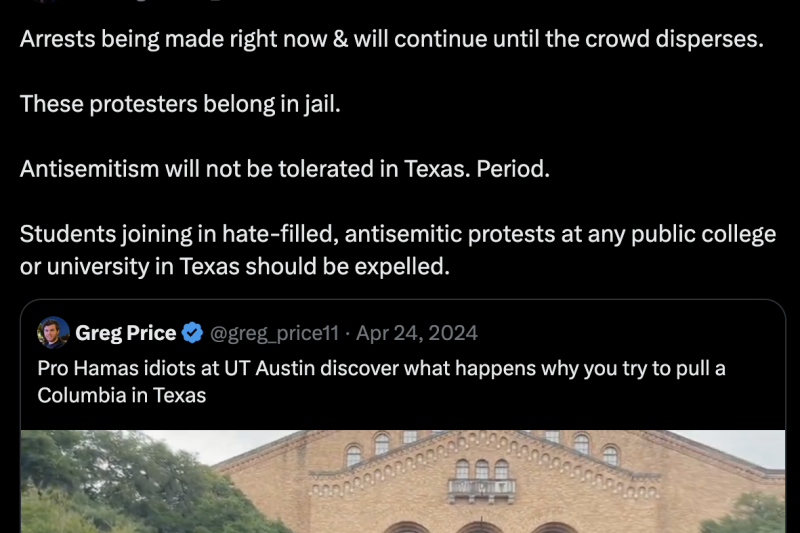
“These protesters belong in jail,” Governor Greg Abbott wrote. “Antisemitism will not be tolerated in Texas. Period.”
In a social media post that day, Abbott wrote, “Arrests being made right now & will continue until the crowd disperses. These protesters belong in jail. Antisemitism will not be tolerated in Texas. Period. Students joining in hate-filled, antisemitic protests at any public college or university in Texas should be expelled.”
Collis said Abbott’s comments could factor into whether the case is viewed as “viewpoint discrimination” tied to their beliefs. Legal scholars note that public officials’ statements made during enforcement actions can be used to infer motive, particularly in First Amendment cases.
Courts may examine whether government actions were driven by neutral safety concerns or by hostility toward a particular political viewpoint. In this case, the plaintiffs argue Abbott’s statements demonstrate an intent to punish pro-Palestinian expression rather than enforce neutral campus rules.
“The plaintiffs will argue those statements show viewpoint discrimination, while the defendants will argue it was simply political speech and that decisions were based on campus policies,” Collis said. “Ultimately, a judge will have to decide what weight to give those statements in light of the other facts.”
Ezra found the allegations plausibly support the students’ claim that pro-Palestinian expression was treated differently from other controversial campus activities, raising constitutional concerns.
ADC National Legal Director Jenin Younes said the ruling ensures the case will move forward to examine the evidence. Younes said the court’s decision is significant because it prevents the case from being dismissed before evidence can be reviewed. She added that the ruling allows students to seek internal communications, policies and law enforcement directives that could clarify how and why the arrests were carried out.
“Our Constitution protects peaceful advocacy, especially on matters of public concern, and the court’s decision makes clear that these claims cannot be dismissed before the facts are examined,” she said.
The case comes amid national debate over how public universities have responded to student protests related to the war in Gaza. In 2024, campuses across the country saw demonstrations calling for divestment from companies linked to Israel, prompting police actions that drew criticism from civil liberties groups.
ADC is litigating the case alongside the Muslim Legal Fund of America, the Law Office of Maria Kari, Lee & Godshall-Bennett LLP, Webber Law and Project TAHA. Attorneys say the next phase of the case will involve discovery and further hearings.
UT-Austin and the governor’s office did not respond to requests for comment.