At Texas Book Festival, Books Bring Readers and Writers Together
By Paul Holm
Reporting Texas
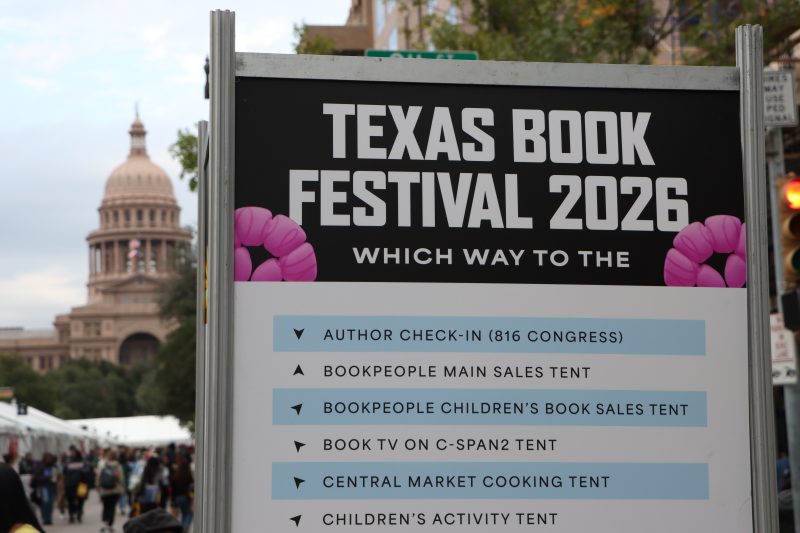
In the shadow of the Texas Capitol, the annual book festival brings readers and writers together. Paul Holm/Reporting Texas
Under the watchful eye of the Texas Capitol, the Texas Book Festival filled several blocks of Congress Avenue this weekend with readers, writers and families gathered to celebrate the written word.
For novelist Johnnie Bernhard, who came to the festival to sign her new book “The Witch of Sonora,” the importance of the gathering could be seen in the children who came downtown Saturday with their families. They had come for something she has valued since her childhood in Pasadena, Texas: the chance to enter someone else’s world.
“Books took me out of Pasadena, Texas,” Bernhard said.
The Texas Book Festival, a weekend devoted to reading, celebrates a key democratic ideal: that stories and the ideas in them belong to everyone.
For Bernhard, the book fest puts that ideal into practice, giving people a place to learn, explore different perspectives and participate in their communities, regardless of how little they have.
The festival brings authors and readers together for conversations, book signings and literary activities. The annual event is free to attend.
Bernhard, a former journalist and high school English teacher, said the gathering offers more than a chance to discover a new author. It creates a shared space where readers can encounter unfamiliar experiences and writers can explain how those experiences become stories.
“I think books are important for everyone, and here we can see how the meat is made,” Bookfest goer Alex Gadsden said.
Bernhard’s own fiction grew out of years spent listening to people. As a journalist, she became interested in features that allowed her to explore a person’s life beyond the immediate news.
“Journalism made me realize everyone has a story,” she said.
Those encounters helped prepare her for a career she had wanted since childhood. At 50, she told her family that if she did not begin writing novels then, she might never do it. She said she went on to write five novels in 10 years.
Her work draws on different settings and experiences, but she described a consistent interest in what connects people across geography, race and religion: the need to love and be loved.
Writing from multiple characters’ perspectives allows her to explore those connections without giving one person sole authority over a story. For readers, she said, encountering different points of view can build empathy.
That process can begin early. Seeing children at the festival reminded Bernhard of watching young readers discover books in libraries.
“That’s planting a seed,” she said.
The festival also gives writers an opportunity to find encouragement in a profession that often requires long stretches of working alone.
“A community of writers is so important,” said Andrew Sean Greer, Pulitzer Prize-winning author of the comic novel “Less.”
For Bernhard, quiet is essential to writing. She spends part of her time in a rural area between Central and West Texas, where the landscape has helped inspire her fiction.
At the festival, that exchange moves in both directions. Readers can hear about the decisions behind a novel as they come up to get a book signed, while authors meet the people who bring their own experiences and interpretations to its pages.
Sarah Pardy, an attendee at the festival, said, “It’s something we should get excited about, you know.”
Bernhard said the gathering also reflects the importance of making literature accessible.
Someone who discovers a book at the festival but cannot afford to buy it can ask a librarian about obtaining a copy.
“I’ve always thought that a library is the best form of democracy,” Bernhard said.
The value of a literary gathering, she said,extends beyond the weekend. A conversation with an author can lead to another book, another question or a visit to the library.
“It doesn’t matter who you are, whether you have money or not,” Bernhard said. “You’re welcome.”