Voices on the Line: Inside the Final Push for Travis County Votes
By Lucas Armbruster
Photography By Lucas Armbruster
Reporting Texas
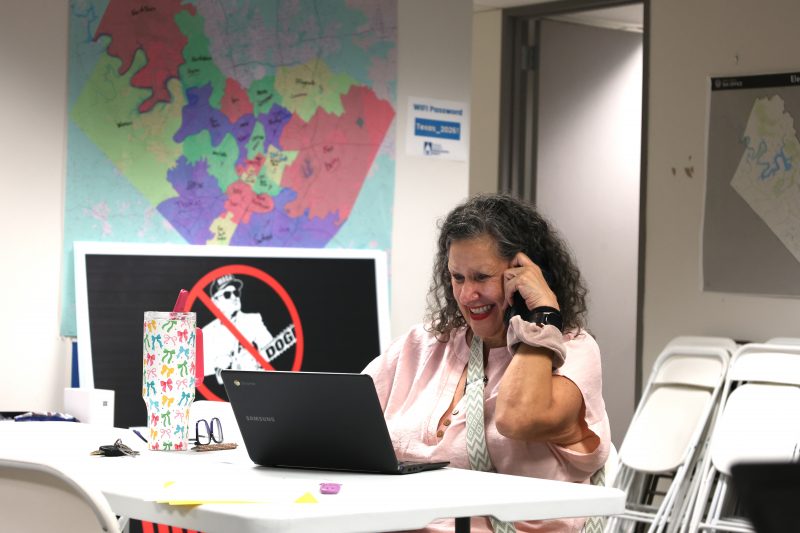
Volunteer Jilliane Seik speaks with a potential voter during a phone-banking shift at the Travis County Democratic Party headquarters in Austin. Lucas Armbruster/Reporting Texas
Inside the Travis County Democratic Party headquarters on Banister Lane, a constant hum of overlapping voices fills the room. Volunteers sit at folding tables, holding their phones and watching their laptop screens automatically cycle through numbers using Scale to Win, a cloud-based predictive phone dialing system.
“This is really an important time, and I’m really hoping for some change,” said George Vance McGee, a Travis County Democratic Party volunteer who returned to phone banking this election cycle after decades away from the headsets.
Yet Vance McGee quickly acknowledges the mental stamina it takes to make final-day calls: “Realizing it’s just a numbers game.”
Out of every 10 calls dialed, only two or three result in an actual pick-up. The rest vanish into voicemails, disconnected numbers, or incorrect records.
When someone does answer, Vance McGee and the other volunteers focus on the core objective of late-stage outreach, asking whether residents have voted early or helping them make a plan for Election Day.
In the days before the Nov. 3 election, this high-volume dialer setup at Banister Lane represented the traditional, centralized approach of campaign field strategy. The Travis County Republican Party ran a different operation, highlighting two contrasting voter-mobilization strategies in Central Texas.
For phone banking volunteers, the challenge isn’t just navigating technical difficulties, but also weathering the emotional consequences of cold outreach.
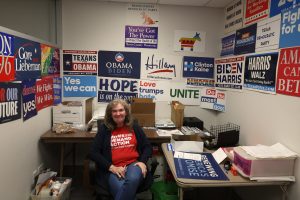
Sarah West, a volunteer with Moms Demand Action and the Travis County Democratic Party, takes a break between phone-banking shifts at the party’s Banister Lane office. Lucas Armbruster/Reporting Texas
“You have to have some thick skin. You can get some rascally people on the phone who are rude, especially if you’re a woman calling,” said Sarah West, a volunteer with Moms Demand Action and the Travis County Democratic Party.
Having participated in both phone banking and block walking for years, West knows the friction points well. Voters are often already weary of late-campaign text blasts.
“I don’t like people calling me either,” she admitted with a chuckle.
What keeps her coming back are the voters on the other end who express firm enthusiasm: “Of course I’m going to vote for the Democrats, I’m going out to vote first thing in the morning, I won’t let anything stop me.”
At the Banister Lane headquarters, field leaders monitored the numbers driving these individual conversations.
Aine Garcia, a regional organizer for the Democrats, noted that between four and 15 volunteers staff the office’s phone bank on any given day. On their peak day this season, the office hit a record 36,000 calls, far exceeding their daily target of 10,000.
For Garcia, the hardest part of the job isn’t hostility on the line, but indifference.
“Combating voter apathy is a never-ending fight,” Garcia said.
“Especially in these local races, it’s gonna come down to the wire,” Garcia said. “And certainly, the votes are going to matter in this case. We actually have a shot in this election cycle to change the party rule in this state, and that’s what keeps me excited.”
Beyond increasing turnout, organizers see phone banking as an additional tool for voter navigation. Andhy Beltran-Garcia, another Travis County Democratic Party regional organizer, noted that their volunteers regularly troubleshoot voter registration status and locate precinct polling stations for residents on the other end of the line.
The Travis County Republican Party operates under a structurally different model. Rather than gathering callers in a central office, it relies on a fully decentralized system, with volunteers calling individually from their homes.
Andrew Hogue, communications director for the Travis County Republican Party, said this year’s outreach messaging centers on a single theme: “Vote different this time.”
While campaigns traditionally reserve phone banks for reliable base voters at this stage of the election, Hogue noted that Republican volunteers are actively reaching out to swing voters in the middle this cycle. That shift in targeting has sharpened hostile reactions.
“Sometimes our phone bankers get angry comments or get cussed at,” Hogue said. Alongside home-based phone banking, he told Reporting Texas that email communications and digital newsletters have seen a resurgence, with open rates spiking higher than in past cycles.
Another part of the Republican late-stage field engagement is engaging with voters at the polls. Susan Blair, a Republican volunteer who phone banked during the 2024 cycle, spent this election week doing poll greeting.
“The main difference between doing phone banking and poll greeting is going to the polls; you never know what you’re gonna get and how the next person you’re talking to voted previously,” Blair said.
Having experienced her share of hostile responses and sharp confrontations in past years, she remains resolute.
“It’s not bravery, but passion,” Blair reflected, pointing to “the future of the country” as her motivation to stay engaged on the front lines.
While volunteers on both sides of the political spectrum handle the immediate tension of hangups and hard conversations, political scientists emphasize that these final-days efforts play a disproportionate role in determining election outcomes.
Melissa R. Michelson, a professor of political science at Menlo College in California and an expert on voter mobilization, explains that the timing of voter contact is critical to its statistical success.
“Late-stage get-out-the-vote outreach is extremely effective. When folks engage in high-quality voter mobilization efforts closer to Election Day, contacts with voters are far more effective than efforts conducted earlier,” Michelson said.
In a deeply polarized political climate, she said , late-stage phone banking serves as a key psychological function, activating partisan identity.
“As Election Day approaches and they increasingly are thinking about whether their party will win or lose, many voters can be nudged to put aside concerns about a candidate to come out to support their party and cement their self-conception as a loyal member of the party.”
As the final volunteer shifts wind down across Travis County, both parties’ contrasting strategies converge on a shared reality. Despite automated software and algorithms, election mobilization still depends on individual citizens willing to pick up the phone.