Critics Say Texas’ New Social Studies Curriculum Presents Narrower Version of History
By Noemi Castanon and Max Mazoch
Reporting Texas
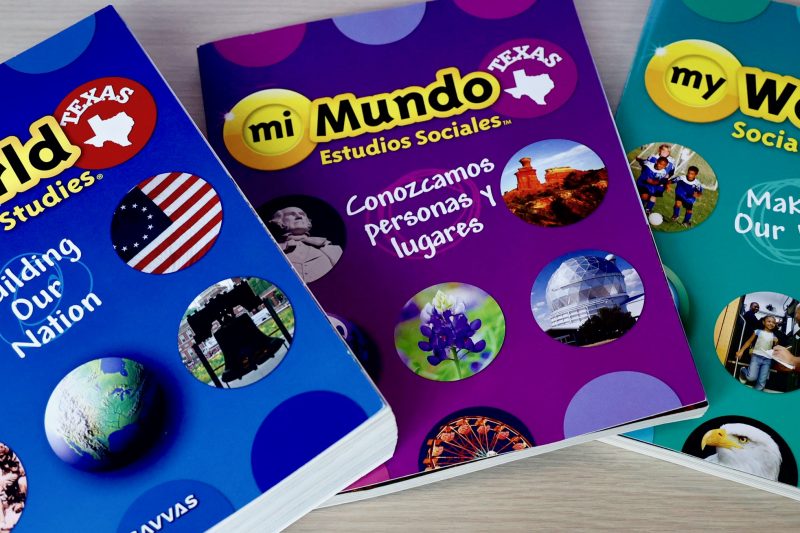
Texas’ State Board of Education is considering widespread changes to the state’s social studies curriculum. Noemi Castanon/Reporting Texas
Illene Barrera has taught social studies at Lehman High School in Kyle for nine years. Though the job can be challenging, Barrera has kept a positive attitude while preparing her students for the future.
“My goal for them is to be able to understand the world around them,” Barrera said, “and knowing the history of the country and then how it affects them, hopefully inspires them to be civic participants.”
But the way Barrera teaches is about to change.
The State Board of Education is considering a new set of Texas Essential Knowledge and Skills, the daily learning objectives that students are expected to know before being promoted to the next grade level. The new curriculum proposes a chronological history framework that emphasizes the role of Western civilization and Christianity in U.S. history, while removing many requirements to teach about minority figures and movements, critics say.
This includes changes like teaching the history of the United States in World War II without the inclusion of the country’s of Japanese internment camps.
In September 2025, the Republican-majority board voted 8-7 in favor of revising the state’s social studies TEKS. A final vote is expected this summer.
Nine content advisers, who are academic and professional experts chosen by SBOE members, decide the key topics that students will be required to learn in the TEKS. The content is then reviewed by work groups, which are composed of members of the public, who make suggestions on how the content should be changed.
But this revision process has created significant concerns.
“We have been working since October, and our work ends in June,” said Yolanda Chavez Leyva, SBOE content adviser and University of Texas at El Paso history professor. She called it “a rushed process that has not done well for the TEKS or for the students.”
Texas Freedom Network, a nonprofit organization advocating for “inclusive and representative education,” has been a critic of the changes.
“A process that should take two years has taken about four months,” Texas Freedom Network political coordinator Levi Fiedler said. This prevents voices from a variety of cultural backgrounds from across the state from sharing their input on the curriculum changes, he said.
Fiedler also said he is concerned that the new TEKS underrepresents the history of American minority groups.
“We’re seeing a lot of omissions about parts of our nation’s history that need to be taught,” Fiedler said. “We’re not seeing enough representation of the Latino community, of the Asian community and of religious minorities.”
The current social studies curriculum includes TEKS for the United Farm Workers movement, women’s liberation movement and other civil rights movements, Barrera said, but many are absent from the proposed social studies changes.
The proposed curriculum “relies on two groups that are involved in the civil rights movement, the African Americans and Mexican Americans,” Barrera said. “The idea is that you see these two movements and then hopefully they can get exposed to other movements and relate them across the board.”
Critics of the plan, including the Council on American-Islamic Relations, say particular groups were intentionally excluded.
“They are being very selective, and they are distorting the history for the sake of empowering one ideology or enforcing one ideology on public schools,” said Shaimaa Zayan, operations manager of CAIR-Austin.
Supporters of the changes, such as the conservative think tank Texas Public Policy Foundation, said the new curriculum’s “chronological framework” will improve students’ understanding of history.
“It’s just good policy,” Texas Public Policy Foundation education director Matthew McCormick said. “If you were sitting down to design teaching social studies to kids, I think a lot of people would come up with what we have now.”
The new curriculum teaches history chronologically through grade levels, meaning earlier grade levels will learn older history that will then be built upon in later years.
McCormick said the new framework helps students understand concepts better and draw connections between different points in history.
“Humans learn chronologically,” McCormick said, “if you don’t have narrative, then you won’t be able to connect things.”
Chavez Leyva said she’s concerned that the new chronological framework will introduce students to topics that are beyond the understanding of particular grade levels, such as requiring students in first through third grade “to understand the free-market system.”
Barrera said she also has worries about the chronological framework.
The new curriculum teaches U.S. history in sixth, seventh and 11th grades, Barrera said. Junior year U.S. history will be a survey class designed to “recognize patterns and changes over U.S. history,” but will require students to remember the knowledge from their middle school classes.
“The only concern is that it requires content knowledge to still be there,” Barrera said. “Sometimes my kids don’t remember what they did yesterday.”
Some worry that excluding groups from the required course is a problem that extends beyond the classroom.
“I am worried about the students who will get the same single narrative in school, at home, at church. They will get a very distorted version of history.” Zayan said.
Fiedler agreed.
“You can’t call something good policy if it deliberately excludes the stories and the histories and the existence of so many people that deserve to be represented,” Fiedler said.
Meanwhile, the five Democratic appointees on the education board have called for a pause in the process after a 2024 tax filing revealed one of the content adviser’s university departments received a $70,000 grant from the Texas Public Policy Foundation, according to a Texas Tribune report.
The state education board is set to finalize the TEKS by the end of June, with implementation beginning in the 2030-31 school year.
Barrera said if the new curriculum does pass, teachers will play a crucial role in the new TEKS.
“We need to encourage students to be more curious. If they’re not curious, we don’t have a curriculum.”