Texas HUB Changes Put Minority-Owned Businesses at Risk of Losing Access to State Contracts
By Erika Gonzalez
Photography By Erika Gonzalez
Reporting Texas

Natalie Nichols, right, owner of Hi-Rez Solutions, reviews camera footage with a colleague during an event in Lockhart in May 2025. Erika Gonzales/Reporting Texas
In the weeks leading up to December 2025, Cortena Williams, owner of a Burleson water damage restoration company, was reviewing proposals and preparing agreements she said could help build up her business.
After years trying to establish herself in an industry dominated by larger contractors, she had moved closer to contracts with major public institutions.
For two years, she said, part of that strategy had centered on the Historically Underutilized Business Program, a state initiative designed to help businesses owned by minorities and women compete for public contracts.
“I was in negotiations for contracts with Parkland Hospital and Texas A&M University, real opportunities ready to move forward,” she said.
Then that changed. Those conversations stopped.
The Texas comptroller’s office issued emergency rules restructuring the HUB program and stripping women- and minority-owned businesses of their HUB certifications. Instead, the program’s focus shifted to helping businesses owned by veterans.
“The comptroller’s actions ended those conversations overnight, not because I wasn’t qualified, but because they eliminated a program that gave me a path to compete,” Williams said.
A state district judge temporarily blocked the changes in April, though the order applied only to the six businesses and associations that filed suit. Trial is set for Nov. 9.
According to data cited in the case and the NAACP Legal Defense Fund, Texas’ HUB program included 15,790 certified businesses before the changes. After the restructuring, only 485 service-disabled veteran-owned businesses remained eligible, leaving nearly 97% of previously certified businesses excluded.
The changes gutted participation in a program that generated 3,634 contracts worth more than $4 billion in 2024, according to the comptroller’s office.
“The program does not guarantee contracts,” said Alphonso David, one of the lawyers challenging the comptroller’s restructuring. “What it does is provide the opportunity to compete.”
David said state agencies were expected to make good-faith efforts to include HUB-certified firms in contracting, and some larger state contracts offered subcontracting opportunities that could help smaller businesses enter public procurement. Those mechanisms created openings for minority- and women-owned firms to compete for work they might otherwise struggle to reach.
Under the restructuring, he said, many of those participation opportunities were largely limited to businesses that still qualified under the veteran-focused rules.
Impact on Contracts, Income and Jobs
For Rubén Mercado Jr., founder of Ipsum General Contractors, a Houston-based civil construction and infrastructure company, the changes quickly translated into losses.
He said he lost a bid worth nearly $1 million and a multiyear $2 million contract with UT MD Anderson cancer treatment and research center. About 85% of his business had been tied to opportunities linked to the HUB program.
“The program didn’t give me anything,” he said. “It opened the door.”
He said the impact was not only financial but disruptive to a business built around growth.
J.R. González, vice president of Texas Association of Mexican American Chambers of Commerce, a statewide network representing Hispanic-owned businesses, said other businesses faced similar risks.
“You could lose 50% or 60% of your income overnight,” he said.
He said those losses could extend to employees, suppliers and communities.
‘A Foot in the Door’
Kenneth Nichols, the son of Haitian immigrants and owner of Nichols Leadership LLC, an Austin-based leadership and organizational development consulting firm, said he viewed the program as a way to enter spaces where small businesses, particularly those historically excluded, are not always invited.
Although he never secured a state contract, he said the certification was still worth the time and effort, representing investment and potential opportunity despite the lack of guaranteed results.
“As a small business owner, you spend hours getting certified, and you still may never get a contract,” he said.
His daughter, Natalie Nichols, owner of Hi-Rez Solutions, a Houston-based photography and creative services business, saw the program through another lens.

“When opportunities become uncertain, people pull back.” Dr. Kenneth Nichols speaks at a leadership session in Austin in Jan. 2026. Erika Gonzalez/Reporting Texas
As a business owner who launched her company more recently, she said the program offered not only potential access to contracts, but visibility.
“The program puts you in front of organizations you might not reach on your own,” she said.
She said the value of the program was in building relationships that could lead to future work.
“When those opportunities disappear, you don’t just lose potential work. You lose connections,” Natalie Nichols said.
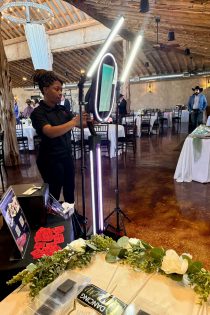
Natalie Nichols provides photography and creative services at a wedding event in Houston in June 2025. Erika Gonzalez/Reporting Texas
Uncertainty for businesses outside the lawsuit
While the preliminary injunction temporarily restored the original HUB rules for the six plaintiffs, uncertainty remained for many others.
The Houston chapter of the National Association of Minority Contractors urged its 165 members to reapply for certification.
For companies outside the lawsuit, Kenneth Nichols said questions remained.
For some owners, the uncertainty extends beyond certification status. It reaches decisions about hiring, investing in equipment or continuing to pursue projects that can take months to develop.
González said that kind of instability can be especially difficult for small businesses operating with limited profit margins and long planning cycles.
“The program exists because documented discrimination existed,” he said. “It was a way to open the system.”
For owners who built growth around that pathway, he said, progress made over time can become harder to sustain.
“When opportunities become uncertain, people pull back,” Kenneth Nichols said. “They delay investment. They stop pursuing growth.”
Natalie Nichols said the risk is not always immediate or obvious.
“Sometimes what disappears first is not the contract,” she said. “It’s the connection that might have led to one.”
For Williams, the question was whether minority-owned businesses would continue to have a fair path into public contracting.
“We’re not asking for special treatment,” she said. “We’re asking for the opportunity to compete on equal footing, like any other business.”