‘You’re Living in a War Zone Now’: Four Latina Writers on Life in South Texas
By Noemi Castanon
Photography By Noemi Castanon
Reporting Texas
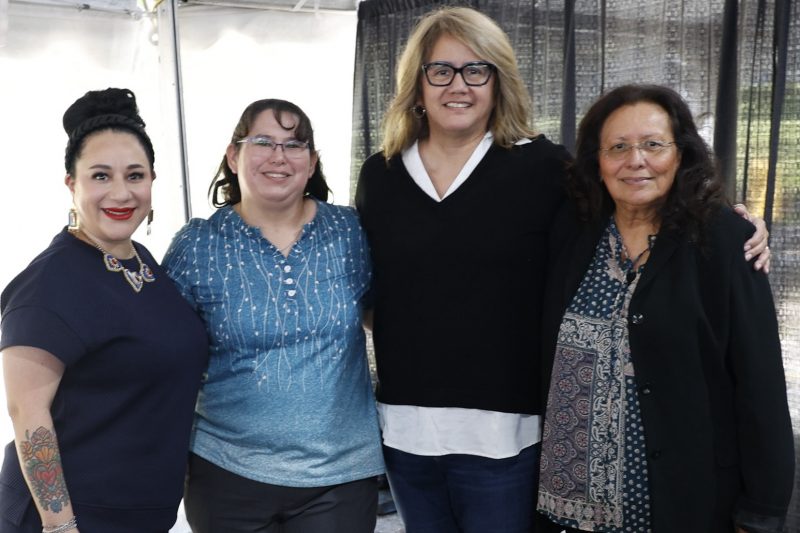
Alicia Reyes-Barriéntez, left, Jody A. Marin, Domino Perez and Santa Barraza pose after their book signing. Noemi Castanon/Reporting Texas
Four authors featured in the new anthology “¡Somos Tejanas!” told the Texas Book Festival Saturday that they will not be silenced in times like these, when many Latinos feel threatened.
“The reason that this book was made is because women are under attack in the United States and Latinos in general are being kidnapped,” said Jody A. Marin, an English professor at Texas A&M-Kingsville and the book’s co-editor.
Marin and co-editor Norma Cantu of Trinity University in San Antonio brought together other Latina writers — Domino Perez, Santa Barraza and Alicia Reyes-Barriéntez — to tell their own varying perspectives of what it means to be Tejanas in each woman’ s section of the book.
Marin moderated Saturday’s book festival panel with Perez, Reyes-Barriéntez and Barraza, and they drew connections from their experiences in the book to what people are going through now.
“Trump’s first administration really brought racists and those who are sexist to the forefront, and they felt emboldened,” Marin said.
Luther Elmore, a professor at Austin Community College who attended Saturday’s discussion, said he found the authors’ stories to be powerful. He denounced what he called racist attitudes in the Trump administration and clampdowns on diversity programs at places like the University of Texas.
“You saying you’re a U.S. citizen in today’s climate, with Donald Trump, that might not make any difference, unfortunately,” Elmore said.
Reyes-Barriéntez, an assistant professor of political science at Northwest Vista College in San Antonio, shared her experience as a child raised in the borderlands in her contribution to the book. She is a proud first-generation college graduate from a Mexican working-class immigrant family.
Reyes-Barriéntez said it was such a natural part of their lives to cross so often, but “all that changed so much; it was almost like overnight, you’re living in a war zone now.”
“I write in honor of little me and all the little girls in the colonias who are running around with their bare feet not really understanding the world,” Reyes-Barriéntez said, “especially when you do not see representation anywhere — not in books, not in television.”
Perez, a UT English professor, has published numerous book chapters and articles on topics ranging from borderlands masculinity and Latinx literature. Her contribution to “¡Somos Tejanas!” is her own experience focused on the tough times during the February 2021 snowstorm that hit Texas during COVID.
“Snow became this really powerful metaphor for me as a child,” said Perez. “The idea of snow is intertwined with community and longing and how much I wanted that.”
“When ‘Snow-vid’ hit I really got to see the way in which the community in Austin, Texas, could come together,” she said, contrasting it with a sense of isolation she felt when her family moved to Houston.
Barraza said art is her means of expression. She is a contemporary Chicana/Tejana artist and founder of Barraza Fine Art LLC, a studio in her hometown of Kingsville.
Barraza designed the book’s cover, seeking to portray that she is an indigenous Mexican from Texas. She said she looked to her family for inspiration. The woman on the cover, she said, is her mother coming out of the house. Behind her stands the tree of life. Her mother, she said, taught her indigenous traditions, and was a strong person who constantly fought to give her as much as she could.
“The cover is really about the empowerment of women and the honor and celebration of mothers,” Barraza said.
She said the paper used for the cover was amate a bark paper used by the Aztecs. She wanted to make sure that the cover portrayed those roots.
The book, Marin said, shows that Mexican-American history is being shared in different ways.
“We have voices, we have pens, and we wanted to ensure that we were going to be heard,” Marin said. “You cannot erase us, you cannot kidnap us.”