While the Government Downplays Big Bend Border Wall Construction, Residents Say It Is Actively Continuing
By Sheldon Munroe
Photography By Sheldon Munroe
Reporting Texas
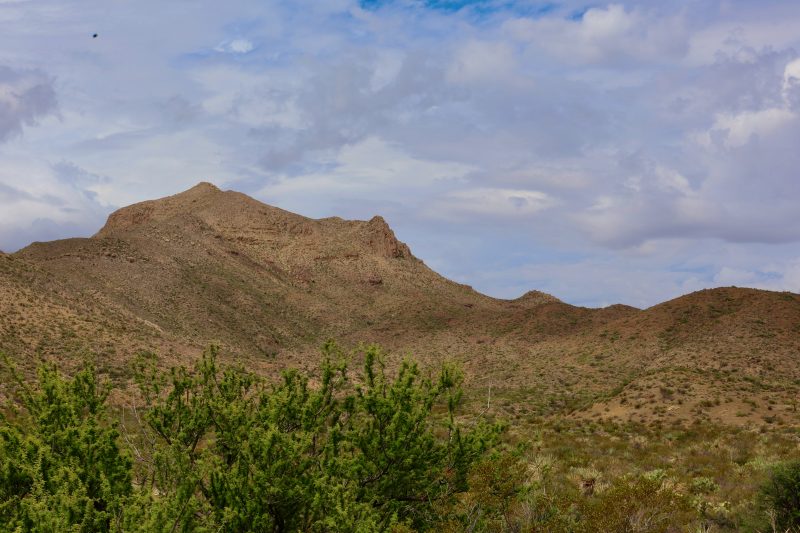
The rugged Big Bend region, home to vast national and state parks, sparks passionate defense from residents who say that the federal government continues to move forward with plans for a wall along this section of the Texas-Mexico border. Sheldon Munroe/Reporting Texas
Despite the federal government’s assertion that construction of the Big Bend border wall has stopped, locals say barrier construction both in the national park and greater region is still underway.
West Texas residents say damage is already visible to one of the most prestigious remaining American frontier landscapes after a months-long process that has involved no public consultation. They say that both public and private lands are being divided with great swaths about to become inaccessible even to owners.
Residents say they find it difficult to accept statements from government officials when they contradict what they are seeing on the ground.
“They’re still preparing to build physical walls and barriers in those areas,” said Michael Ryan, a retired Big Bend National Park ranger with over 20 years of service and a longtime resident of the region. “We don’t trust them.”
A spokesperson for the Border Patrol’s Big Bend Sector recently told Marfa Public Radio that there are no plans to build a border wall in Big Bend Ranch State Park, which borders Big Bend National Park. The U.S. Customs and Border Protection website now describes a plan to establish “virtual wall” technology that would alert agents when people cross through the national park stretch.
Many residents call these recent Customs and Border Protection statements and website updates as little more than wordplay intended to deflect public attention and criticism while construction continues.
People also point to the awarding of contracts as evidence that construction is actively underway. In March 2026, the U.S. Department of Homeland Security awarded Barnard Construction Co. a $960 million contract for border barrier construction along the Rio Grande from the Hudspeth-Jeff Davis County line to Ruidosa and Fisher Sand & Gravel a $1.2 billion contract for a vertical barrier from Ruidosa through southern Presidio County to the upper reaches of Colorado Canyon.
Even if it is not a traditional physical wall, images from the valley show multiple rolls of spring steel razor wire coiled along the landscape.
“They didn’t get a wall; they got wire,” Ryan said. “Razor wire. This is like what you see in prisons, in multiple areas, in the river and on the shore. That’s what we have down in the valley right now.”
The Big Bend Sentinel in October detailed the construction of a concertina wire fence spanning more than 20 miles, from near the Presidio International Bridge downstream to Alamito Creek.
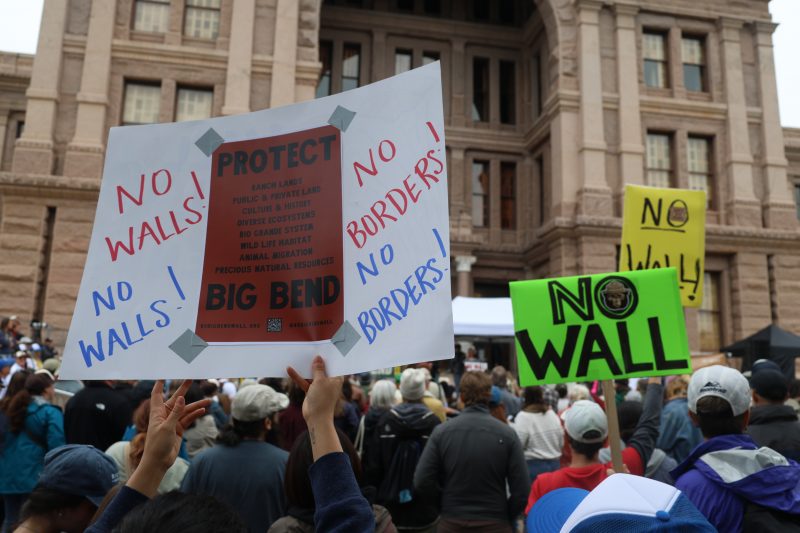
Protesters gathered at the Texas Capitol this month to urge the federal government to drop plans for border barriers in the Big Bend region. Sheldon Munroe/Reporting Texas
On Feb. 17, the Department of Homeland Security announced it was exercising its authority under Section 102(c) of the REAL ID Act of 2005 to waive numerous environmental and cultural protection laws including the National Environmental Policy Act, the Endangered Species Act, the Clean Water Act and the National Historic Preservation Act for the “expeditious construction of a border wall.”
Despite criticism for a lack of clarity and limited public input, U.S. Customs and Border Protection continues to use an online map as a primary method of updating the public on its infrastructure plans.
Earlier proposals outlined up to 517 miles of steel border wall, including sections that could cut through both Big Bend National Park and Big Bend Ranch State Park. More recent revisions from the Customs and Border Protection website now show plans for roughly 175 miles of steel barrier running upstream from Fort Quitman to Presidio, paired with surveillance and detection technology extending through the broader Big Bend region.
Pushback against these efforts has been swift and bipartisan. Organizations such as “Save Big Bend” have helped to raise awareness and mobilize opposition.
On April 4, the group organized a protest at the Texas State Capitol, where thousands of Texans condemned actions by the Department of Homeland Security.
Protesters made it clear they are defending the entire Big Bend region, not just Big Bend National Park or Big Bend Ranch State Park. “There are lots of areas on either side that we also care very deeply about,” one member of Save Big Bend said.
Residents are also angry with the government’s implementation of eminent domain. Landowners in the region say letters from the Department of Homeland Security say that their property is being taken for the construction of a border wall.
“On my land, it’s still a physical wall on the map,” said Stephen Dempsey, a property owner in the Big Bend region. “Just north of Presidio, that goes all the way up to Candelaria and beyond. That is the entire border of Texas they are trying to wall off. They are just taking it. There is not a lot we can do other than what we are doing.”
Watkins said he and his wife purchased 40 acres along the border in 2020 with plans to homestead and retire there. About six weeks ago, he received a letter stating that a portion of his land would be acquired for the wall’s construction.
He said officials had mapped out the wall’s route, and because of a bend in the river, about half of his property would effectively be cut off and left on the other side. He added that compensation would only cover the narrow strip of land where the wall and access road would sit, rather than the larger portion he says would be lost.
Another resident said their family would lose access to ancestral land. “My siblings and I received a letter saying that because of where the border wall will be constructed, we will no longer have access to the land where my parents’ and grandparents’ graves lie,” the resident said.
“Maybe my voice doesn’t matter,” Watkins added, “but it is not just me. It is a whole bunch of landowners who are essentially being run out of town in the name of border security that doesn’t need to be there.” Those from the region frequently expressed their view that the area’s harsh, rugged and remote geography is a barrier in and of itself.
In 2025, the Big Bend sector accounted for roughly 1 percent of illegal U.S. border crossings.
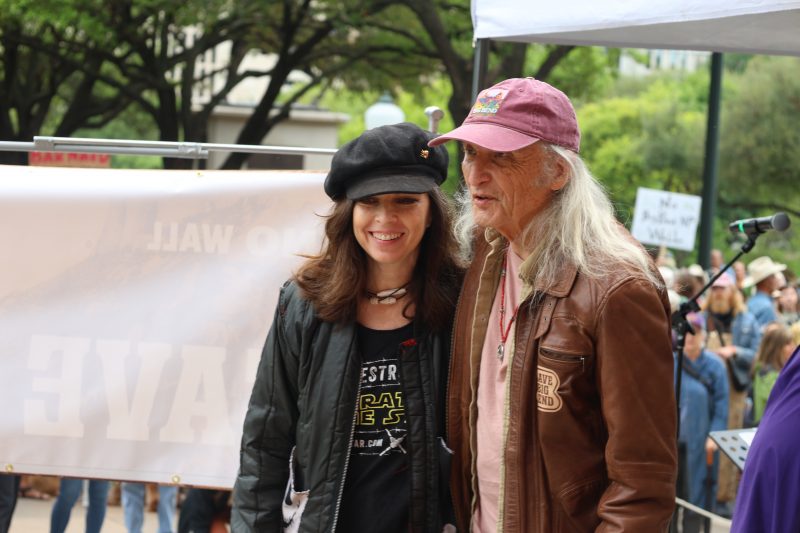
Texas musicians Amy Lee Nelson, daughter of Willie Nelson, and Jimmie Dale Gilmore shared their voices at the Big Bend border wall protest at the Capitol. Sheldon Munroe/Reporting Texas
Among those expressing opposition at the Capitol protest were Texas musicians Amy Lee Nelson, daughter of Willie Nelson, and Jimmie Dale Gilmore, who performed songs including “This Land Is Your Land” before the crowd, many of whom held signs reflecting bipartisan support.
Nelson says the wall is rooted in division rather than inclusion and threatens existing bonds.
“These are our neighbors, and we need each other,” she said. “There’s such a big lie behind building a wall to protect ourselves from people who are our neighbors, our spirit family. And then to destroy nature in the process … we’re supposed to be here so we can get along with each other.”