Texans Demand Special Legislative Session for Data Center Debate
By Rachel N. Madison
Photography By Rachel N. Madison
Reporting Texas
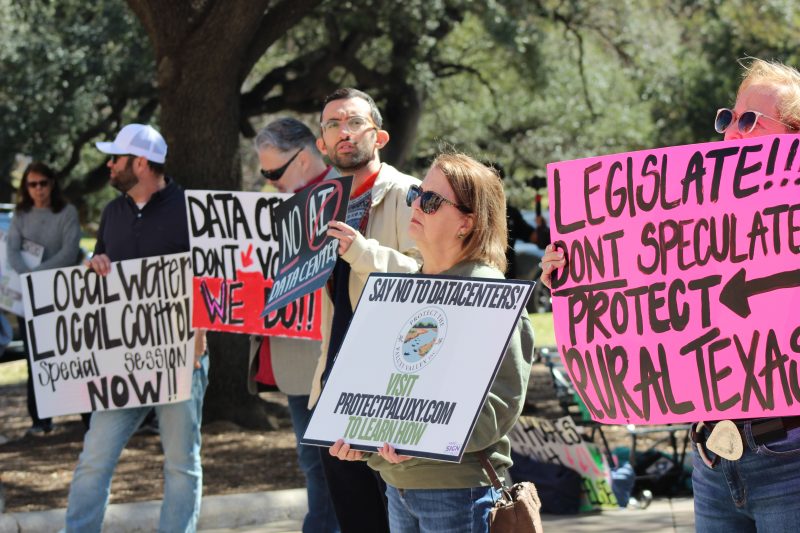
Protesters opposing data centers rally at the Capitol to call for state action. Rachel N. Madison, Reporting Texas
Protesters at the Texas Capitol called for the Legislature to stop the rapid spread of data centers Monday, urging representatives to hold a special session to discuss the environmental impacts of the new technology.
“My land is being threatened,” said Rena Schroeder, a Republican candidate for a state Senate seat in South Texas. “We the people are tired of our voices not being heard, especially rural Texans.”
Schroeder was one of seven anti-data center activists to speak at the Rally for Water protest, which brought a crowd of two dozen concerned Texans to Austin to call for legislative action.
“Small towns and rural communities are under threat from big tech,” Adrian Shelley of Public Citizen said during the rally. “We don’t want our land, our water and our energy to be given away.”
Data centers accounted for 4.4% of the United States’ electricity consumption in 2023, according to congressional data. By 2028, that is expected to exceed 10%.
Texas is at the heart of it all, coming in second to Virginia for the state with the most data centers in the country with over 400 active data centers used to support growing AI infrastructure. The number continues to grow as industry demands increase.
Recent data center approvals have caused a wave of pushback across the state as residents face the environmental impacts of the industry.
This month, Hood County approved a new 2,100-acre hyperscale plant near Fort Worth that will host nine data center campuses and several natural gas power plants, despite resident calls for a moratorium to assess the area’s ability to support infrastructure. Last year, Lacy Lakeview City Council voted to annex 520 acres for Waco’s first proposed AI data center, which will come with a 1.2 GW gas plant. There are dozens of other examples of proposals across the state.
Residents at Monday’s protest, many of which drove nearly three hours from Hood County and surrounding areas to attend the rally, said they will continue to fight until the government stops this development.
Waco resident Teresa Moore said her top concerns are the impacts on water, rising electricity bills and health issues related to air and water pollution. Moore has lived in the area her whole life and is now a member of the Stop Waco Data Centers Facebook group.
“We want our elected officials to do right by the citizens of Texas,” she said. “To listen to us and our concerns and not to be so concerned with the big bucks that may be coming into Texas.”
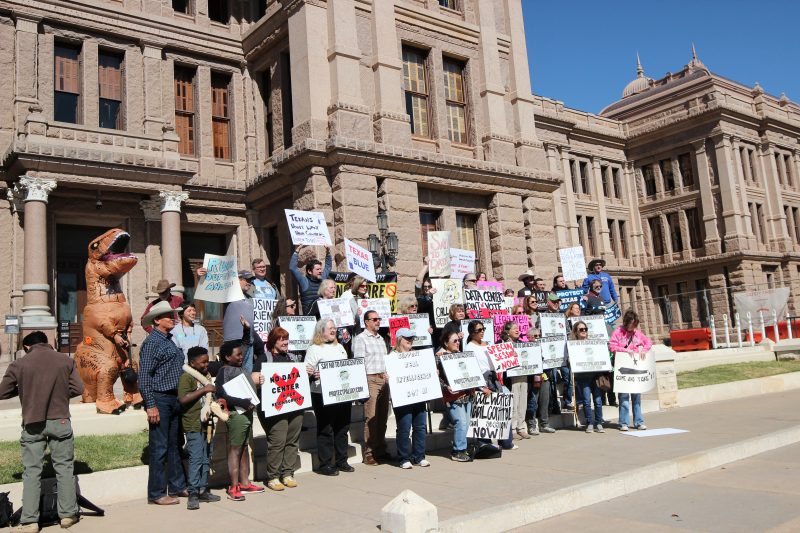
Organizers and speakers pose in front of the Capitol after calling on legislators to pause all data center developments. Rachel N. Madison, Reporting Texas
Speakers emphasized the environmental impacts of the centers, which pose threats to local communities air quality, water resources, and overall health.
“The water consumption of these power plants is completely unsustainable, especially considering the fragile state of regional aquifers,” said Brian Crawford, a member of the Protect the Paluxy Valley advocacy group. He cited concerns about the impacts to the Paluxy River and surrounding ranches and farmland.
“Lake Granbury goes almost dry nearly every year, and pulling all of this out is really going to make a big impact,” said Hood County resident Lynette Green, who is also a member of the group.
Residents also worry about the impacts of new gas-powered plants that will support the centers.
Just last month, the Texas Commission on Environmental Quality issued the largest air quality permit in the country for a series of gas plants to sustain AI data center campuses in the Permian Basin, which will produce enough energy to power a small city.
Hood County residents fear the impact that the new plants will have on their area southwest of Fort Worth.
“The CO2 output from these plants will equal that of at least one and a half billion typical passenger vehicles,” Crawford said.
In addition to water and air quality impacts, “electricity prices are going to double,” Clayton Tucker with the Texas Farmers Union said.
“The more I learn about data centers, the more concerned I become,” he said, blaming the industry for lies they tell to locals and insisting there is no such thing as a sustainable data center.
“It’s going to be my generation and the next generation that’s gonna pay the price.”
Speaker Chris Paulsen also stressed the generational impact of today’s building boom.
“I want grandkids to inherit land that has water and a state with good air quality, to afford electricity,” he said. “I don’t want around every corner to either see a power plant or a data center.”
“I want grandkids to inherit land that has water and a state with good air quality, to afford electricity,” said Chris Paulsen, who spoke at the rally. Rachel N. Madison, Reporting Texas
Like many at the rally, Paulsen moved to rural Texas to escape the noise and pollution of the big cities. Ironically, the wide open spaces and minimal regulation are exactly what private equity needs to thrive, he said.
Speakers condemned Republican representatives for letting profit outweigh citizen protection.
Many Republican protesters said representatives should worry about their party support. Maybe rural towns will start to turn blue, Paulsen said.
P.A. Wilson with Stop the Waco Data Centers had a clear message for legislators: “we are watching them and we know where the money is going.”
Protesters and speakers hope the rally will urge Gov. Greg Abbottt to call a special session to discuss data center impacts on rural Texans. Ultimately, they hope that legislators will enact a statewide moratorium on data center development until proper assessments are made about the impacts of proposed projects.
While the protest was mostly Hood County and surrounding residents, all Paulsen believes Texans should be concerned about data center impacts.
“We all breathe the same air and drink the same water,” he said to the crowd. “So, if you think it’s not in your backyard, it is.”
Tucker believes that all Texans must come together in order for legislatures to act.
“If we work together as city and country folks, as Democrats and Republicans, as farmers and food eaters, we can win.”