Months After ICE Raid, Valley Flea Market Still Largely Deserted
By Natalia Rodriguez
Photography By Natalia Rodriguez
Reporting Texas
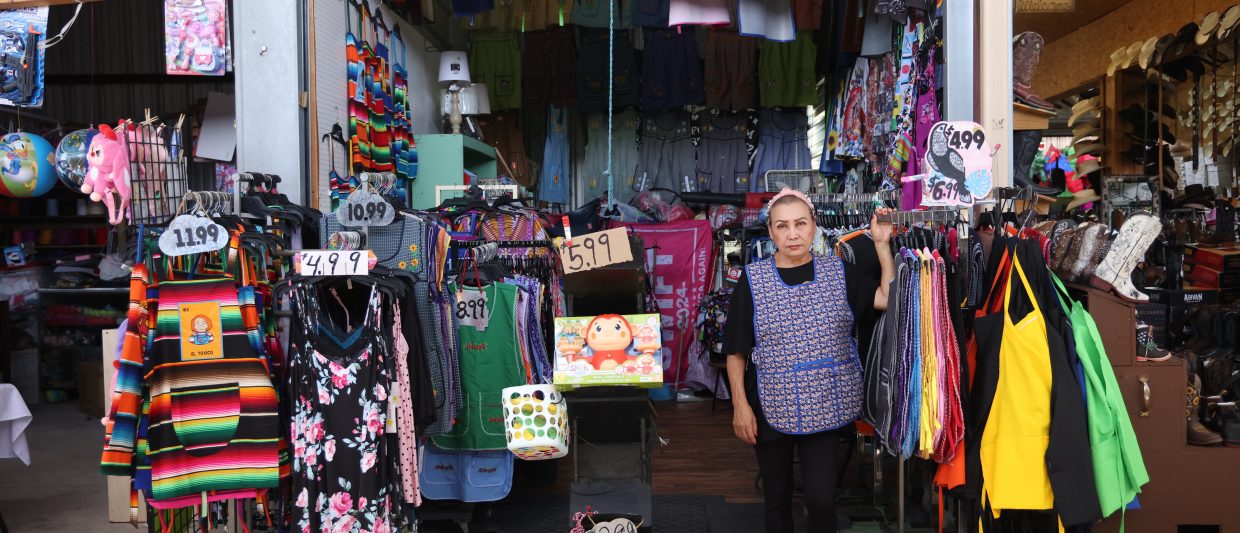
“There’s no one here because everyone is scared,” said vendor Silvia Cavazos. Natalia Rodriguez/Reporting Texas
ALAMO — Hallways full of families. Vendors in stalls scrambling to attend to every customer. Dance floors full of laughter and community.
For decades, these scenes would play out at the Mercadome Flea Market in the Rio Grande Valley town of Alamo.
Today, those same hallways are empty. Many stalls in the flea market, or “pulga” in Spanish, are closed, and the dance floor is occupied by only a few clinging to maintain the energy that existed before Immigration and Customs Enforcement agents raided the market last June.
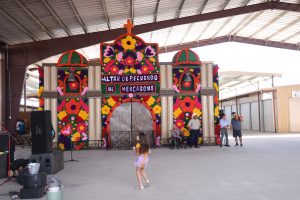
A girl dances alone on the Pulga de Alamo dance floor. Natalia Rodriguez/Reporting Texas
“There’s no one here because everyone is scared,” Silvia Cavazos, a flea market vendor of almost 10 years, said in a December interview. “It’s very hard on a lot of the stores that sell their things in the pulga. A lot of shops here have closed down, and I’ve stopped seeing a lot of customers that used to come every week.”
The Rio Grande Valley has been one of the most targeted areas by President Donald Trump’s immigration enforcement because of its location along the U.S-Mexico border. As of December 2025, ICE had detained more than 9,000 people in South Texas, almost one-fifth of total Texas detentions in Trump’s second term, the Texas Tribune reported. About 100,000 Hidalgo County residents hold an undocumented immigrant status, according to another Texas Tribune report citing 2019 data from the U.S. Census and the Migration Policy Institute.
The American Immigration Council estimated in 2024 that the economy would shrink 4.2% to 6.8% with a deportation rate of 1 million people per year, similar to the economic shrinkage of the 2008 recession. The Trump administration has set a goal of 3,000 ICE arrests per day or 1,095,000 each year.
Cavazos said she has seen Valley residents who have stopped leaving their houses and knows others who have been detained by ICE.
The fear is bad for business at the Mercadome, nicknamed “La Pulga de Alamo.” The market has been prominent in Valley culture, not only for its weekly dances, highlighted in 2024 by the New York Times, but for its accessibility to vendors and affordability for buyers. The flea market has served as a one-stop shop for everything from window tint, kitchen aprons, cowboy boots, fresh produce and even haircuts at incomparable prices.
“Pulgas are very big businesses in border regions,” said Carlos Sanchez, director of public affairs for Hidalgo County. “They’re big because they don’t require a degree or any formalized training. It really is a kind of proprietorship that drives these businesses. It is a cultural thing. You can tell how significant this type of economic activity is.”
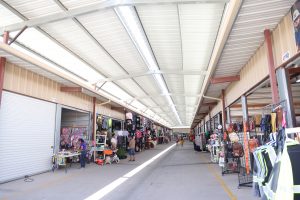
“From my childhood memories, I don’t think I ever recall seeing an empty stall.” Natalia Rodriguez/Reporting Texas
The loss of business at the pulga has not only had economic effects, but has also an emotional toll on those who grew up visiting it.
“From my childhood memories, I don’t think I ever recall seeing an empty stall,” said 21-year-old Teresa Garza. “It’s heartbreaking. One of the first things that comes to mind is having my hand yanked away from my mom because it was so crowded. You could not get through without getting separated. Now so many stalls are empty.”
The Mercadome Flea Market would not disclose exact numbers of how many vendors have closed since the June raid.
Garza said ICE raids’ impact on a community’s culture often does not get mentioned.
“It’s something you don’t think about until you see it,” Garza said. “Witnessing that change and how ICE and immigration issues have actually impacted everything in my day to day life in my own community, it makes you want to cry. There’s so much fear in a place that used to be so warm.”
Parts of this story were translated from Spanish to English.