Inside Texas Immigration Detention: Families, Health Concerns and Lasting Impact
By Erika Gonzalez
Reporting Texas
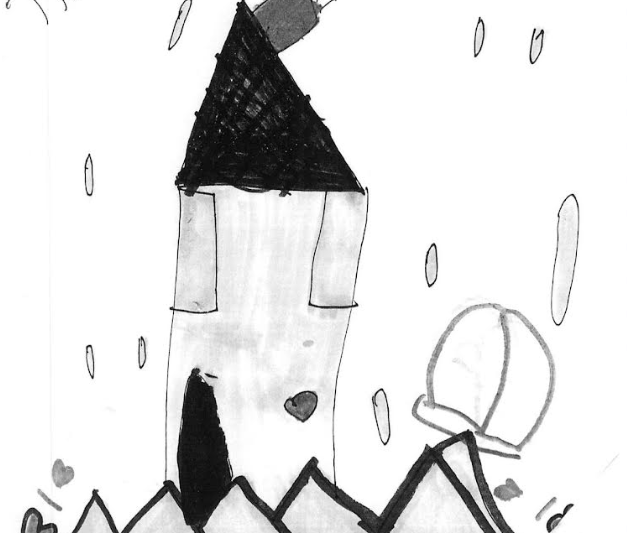
A drawing made by Kelly Vargas’ daughter while they were detained for two months at the Dilley family detention center in Texas in late 2025.
Four months after leaving the family detention center in Dilley, Kelly Vargas’ 6-year-old daughter still wakes up at night asking about “the bad ICE men.”
Vargas, a Colombian mother who had lived in New York for more than a year before being detained in late 2025, is now trying to rebuild her life in Bogotá, Colombia. But the effects have stayed with her.
“She doesn’t forget,” Vargas said, adding that her daughter often asks, “Mom, do you remember when we were in jail?”

Kelly Vargas sits with her daughter in New York in May 2024. Photo courtesy of Kelly Vargas
She said their detention began when they showed up for an immigration appointment, hoping to legalize their status after entering through an unauthorized border crossing. Instead, she said, they were taken into custody on the spot.
For nearly two months at a family detention center in Dilley, 70 miles south of San Antonio, mother and daughter lived through what Vargas described as constant illness and fear, including long nights without sleep.
Others in Texas have described similar experiences. Immigration detention centers have drawn growing attention as advocates, lawyers and medical professionals tell of problems with health care, crowding and oversight.
More than 68,000 people are held nationwide in over 200 immigration detention facilities, according to U.S. Immigration and Customs Enforcement, roughly the population of Portland, Maine. Texas alone has 27 of those facilities, more than any other state, according to Statista.
At the Dilley family detention center in South Texas, one of the largest in the country, the population increased from fewer than 500 people in October 2025 to 1,332 by late January 2026, including about 800 children, according to NBC News, citing data from organizations that monitor immigration detention.
In recent months, reports have confirmed cases of tuberculosis and COVID-19 at the Camp East Montana detention facility in El Paso. Over a 44-day period, at least three detainees died in custody at that site, including cases later investigated as asphyxiation and suicide, according to news reports.
Experts said these cases point to broader problems.
“The very existence of family detention is highly problematic,” said Elissa Steglich, an immigration law professor at the University of Texas, who said any period of detention has negative effects on children and “feels like punishment.”
Inside Dilley: Life in Detention
When Vargas arrived at the Dilley facility, she said the first thing she felt was confinement, explaining that “you feel like you are in a prison.”
The complex is divided into sections with names like “bear,” “butterfly” and “frog,” but families and immigration lawyers said the structure feels more like a jail than a place designed for children.
Rooms are shared, with bunk beds holding multiple families at once, and in many cases eight to 12 people share a single space, according to immigration attorney Kate Lincoln-Goldfinch, who has represented families detained there.
Vargas said the lights stayed on 24 hours a day, which made her migraines worse, while the noise never stopped, with radios, guards and doors closing through the night.
Sleeping was almost impossible, she said, adding that daily routines were strict and tightly controlled. Detainees had to wake up at 5 a.m., with breakfast at 6 a.m., lunch at 11 a.m. and dinner at 5 p.m., and by 8 p.m., everyone had to return to their rooms.
During the day, Dilley offered few activities for children, she said, adding that they were sometimes allowed brief access to a gym but only under strict restrictions.
“Everything is no, no, no. Don’t run. Don’t shout,” Vargas said.
To calm her daughter, Vargas said she told her they were on vacation, adding that “it was the only way to keep her from being scared.”

Kelly Vargas, left, with her husband, Yerson, and their daughter while living in New York in 2025. Photo courtesy of Kelly Vargas
For Children, Education Is Limited
Children receive about one hour of education per day, Vargas said, while the quality of that instruction is low, Lincoln-Goldfinch said.
“In many cases, it is basic worksheets, without real structure,” she said.
Vargas said her daughter would come back with drawings, adding that “that’s all they did.”
Her daughter, who had enjoyed school in New York, began to struggle, and “she told me, ‘Mom, I don’t understand the teacher,’” Vargas said.
Gaps in Health Care
Access to health care is also limited, according to Vargas and experts, who said detainees are evaluated by medical staff when they arrive but receive mostly basic medication afterward.

One of several drawings made by Kelly Vargas’ daughter during her time at the Dilley family detention center in Texas in late 2025. The drawing shows the child with her cat, which she left behind the day she was detained.
“They give you ibuprofen or acetaminophen for everything,” Vargas said.
Steglich said this reflects a pattern seen in detention centers, adding that “we have seen repeated medical neglect and abuse.”
Although legal standards require adequate medical care, including oversight under the Flores Settlement Agreement, a court agreement that sets minimum standards for the treatment of children in immigration detention, Steglich said there are “significant gaps in oversight and basic care.”
In Vargas’ case, her daughter developed a persistent cough, and “they said it was allergies,” she said.
After returning to Colombia, doctors found she had severe lung congestion.
Pediatrician Lara Jones, who has worked with detained families, described similar cases, including a baby who did not receive proper care for two days.
“That is medical neglect,” Jones said, adding that detention centers pose immediate risks for children because “these are environments where diseases spread easily.”
She also said the detention center failed to meet basic needs for survival, including access to clean water.
Vargas agreed, saying that “the water came out dirty, with green particles.”
Jones added that some families have reported having to pay for bottled water, even when children are sick, saying “that is not a luxury. It is a basic need.”
A System Under Scrutiny
As concerns grow about conditions inside detention centers, some experts say holding families there is not necessary.
“It is a policy decision,” Steglich said.
Doctors, including ones, neonatologist Ashley Cozzo and pediatric critical care physician Anita Patel, said that decision is already affecting children, leading to illness, emotional distress and disruptions in their development.
In a letter signed by thousands of health professionals, they urged the federal government to release children from detention, saying the conditions pose direct risks to their physical and mental health.
“Detention is not a safe environment for children,” the letter said, warning that even short stays can have lasting effects.
“These are not places where children should be,” Jones said.
Not everyone agrees. Ira Mehlman of the Federation for American Immigration Reform, an immigration policy group that advocates for more restrictive immigration policies, said family detention centers serve a purpose.
“The goal is to keep families together,” he said, adding that these facilities allow legal processes to move forward without separating parents and children.
“When laws are broken, there are consequences, and unfortunately children sometimes face them,” he said.
Rebuilding a Life After Detention
In Bogotá, Vargas is trying to rebuild a routine for her daughter, but she said the effects have not gone away.
Her daughter cries most days and often has nightmares, waking up at night asking about what happened in Texas, Vargas said. She has also started wetting the bed again and has struggled in school.
Vargas said she tries not to think too much about what happened.
But the memories return.
“That doesn’t go away,” she said. “I don’t think we will ever forget.”