In an Age of ‘Protein Maxxing’ and ‘Boy Kibble,’ Experts Urge Caution
By Samantha Rubin
Photography By Samantha Rubin
Reporting Texas
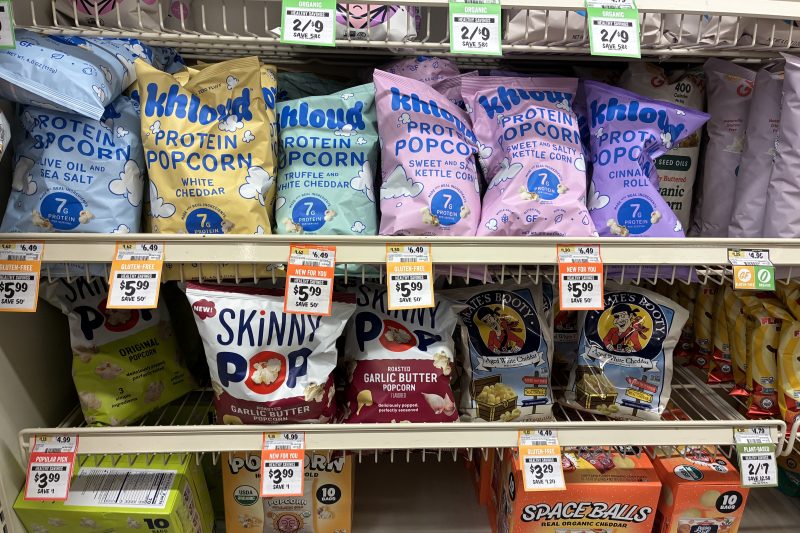
Store shelves are teeming with protein-packed products, but dietitians suggest most people get the protein they need. Samantha Rubin/Reporting Texas
Protein popcorn. Protein water. Even protein coffee.
Across grocery stores and social media feeds, marketers are pushing protein — especially among young men seeking muscle, discipline and an idealized physique.
Online, the trend has taken on names like “protein maxxing” and “boy kibble,” and focuses on meals built almost entirely around protein intake. But nutrition experts say the surge is less about actual dietary needs and more about marketing, misinformation and shifting body image standards.
“There’s always some nutrient that’s trending,” said Curissa Groll, a dietitian who specializes in eating disorders. “Right now, protein has this reputation of building muscle and people grab onto that.”
That reputation has been amplified by fitness influencers whose content links high-protein diets to visibly lean and muscular bodies. Companies have followed closely behind, introducing protein-enhanced versions of foods that traditionally contained little to none.
“There’s a lot of value placed on a body that looks lean,” said Kamran Khan, a registered dietitian who works with clients experiencing disordered eating. “Protein just happens to be something that gets marketed as the way to get there.”
Mallary Tenore, a journalism professor at the University of Texas at Austin and author of “SLIP: Life in the Middle of Eating Disorder Recovery,” said the shift reflects how quickly messaging around food can change even when people’s actual nutritional needs do not.
“It just feels like one more way to try and make people think that their existing diet is not good enough,” Tenore said. “In the 1990s, everything was low-fat. Now we’re seeing the protein swing.”
Despite the messaging, experts say most Americans are already consuming enough protein.
“We have overwhelming evidence that the average American adult meets or exceeds recommended protein intake,” said April Davis, an associate professor and director of the graduate dietetics program at Washington State University.
Khan called much of the information circulating online “bro science” — advice that may apply to a small group such as bodybuilders, but which is often generalized to a much wider audience.
Tenore said that disconnect is partly driven by constant exposure to messaging about what people “should” be eating.
“When you walk into a store and see protein products everywhere, it starts to feel like that’s what you’re supposed to be consuming,” Tenore said. “People are being bombarded with messaging about what’s healthy.”
Supporters of the shift toward higher protein intake say it reflects an effort to improve overall diet quality. New federal dietary guidelines backed by Health and Human Secretary Robert F. Kennedy Jr. encouraged Americans to prioritize protein alongside whole, nutrient-dense foods while cutting back on added sugars and highly processed products. The wellness website Healthline describes protein as a macronutrient that is good for bones, increases muscle mass, boosts metabolism and helps the body repair itself after injury.
While protein intake has increased, experts say other essential nutrients especially fiber are sometimes overlooked. Fiber, found in foods such as fruits, vegetables, legumes and whole grains, plays a key role in digestion, gut health and immune function.
“By focusing so heavily on protein, people are missing out on whole foods with nutrients that help the body combat disease,” Davis said. “That can increase risks for cardiovascular issues and inflammation.”
Khan says the protein push is more about sales than nutrition.
“It’s easier to market protein,” Khan said. “It’s easier to package, easier to sell and easier to associate with a certain body type.”
High-protein diets can lead to unintended health consequences when they displace other nutrients. Khan said inadequate fiber intake can affect gut health, which is closely tied to overall well-being.
“The gut is connected to everything,” Khan said. “If fiber intake is low, that’s going to have an impact.”
In some cases, excessive protein consumption can strain the kidneys, particularly over long periods or among individuals with underlying health conditions.
Beyond physical health, experts say the trend is influencing how young men think about food and their bodies.
Khan said he is seeing an increase in male clients, including teenagers, who report body dissatisfaction and disordered eating patterns tied to diet trends and social media.
Louis Laves-Webb, an Austin psychotherapist, said “eating disorders hide most of the time in the shadows.” Laves- Webb said eating disorders in men often present differently than in women.
“In my opinion women that struggle with eating disorders are focused a bit more internally: self-esteem, power, beauty and self-inflicted pain,” he said. “Many men’s eating disorders are a bit more externally focused: success, courtship and external validity. Also, of course, with an internal contribution — but more consciously focused externally.”
Groll identified adolescents, particularly those between 12 and 18, as especially vulnerable to these messages.
“At that age, people are trying to fit in and are more likely to internalize what they see,” she said.
Tenore said these pressures are often shaped by media, peers and broader cultural messaging even when they are not explicitly discussed at home.
Laves-Webb said muscle-building culture plays a role in masking disordered eating behavior.
“Social media, body building, CrossFit has not only normalized this activity but also concreted it as a fundamental part of success like career goal, financial success, or being in a relationship with a beautiful mate,” Laves-Webb said.
Online portrayals of the trends can mask their potential harm. Terms like “boy kibble” often portray repetitive, protein heavy meals as humorous or efficient rather than restrictive.
“I do think that kind of framing makes it harder to recognize when something isn’t healthy,” Khan said.
Tenore said these trends often fall under a broader “wellness” umbrella framing that can obscure risks.
“Wellness can sometimes be a guise for diet culture,” she said. “It can make harmful behaviors seem normal or even positive.”
Experts say behaviors such as rigid food rules, obsessive tracking of nutrients and avoiding social situations involving food can be early signs of disordered eating.
Some also point to orthorexia, which is an unhealthy obsession with eating healthy. This pattern can emerge when people become fixated on hitting certain nutrition goals.
“When it becomes obsessive or starts interfering with daily life, that’s when it shifts into something more concerning,” Groll said.
The rapid rise of protein-focused products is also being driven by market demand.
Companies monitor trends on social media and respond quickly, often prioritizing what sells over what is nutritionally necessary.
“It’s very much about what’s popular and brings in dollars for many industry influencers,” Davis said.
Tenore said the cycle reflects a broader cultural pattern.
Diet trends, she said, “spread quickly because people are looking for ways to improve their bodies and companies respond to that.”
While protein remains an important part of a balanced diet, experts emphasize that no single nutrient should dominate eating habits.
“Nutrition is more nuanced than people make it out to be,” Groll said. “A balanced diet with a variety of foods is what supports overall health.”
Anyone lingering at the shelves of protein-packed foods should question whether their choices are based on actual needs or outside influence, Tenore said.
“Are people buying these products because they want them,” she asked, “or because they feel like they need them?”