Iconic Texas food brands stay out of politics. Midterm candidates are using them anyway.
By Adele Doat
Reporting Texas
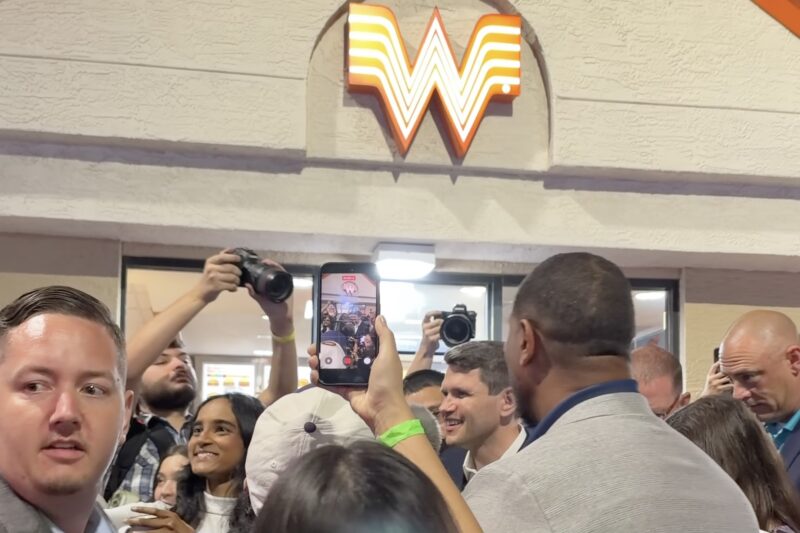
“Clear eyes, full hearts, spicy ketchup.” James Talarico visits an Austin Whataburger. / Photo courtesy of Martin Taxy
A frenzied crowd of supporters met Democratic Senate nominee James Talarico as he emerged from the Whataburger on Guadalupe Street after an October campaign rally at the University of Texas at Austin.
Posts of his visits soon inundated his social media page.
“Whatalegend,” “Whataguy,” “a true Texan,” some commented under one of the six posts about his Whataburger appearance.
Whataburger is not the only emblematic Texas food brand Talarico has featured on his Instagram profile in the final stretch of the 2026 midterm election campaign. Last week, he also stopped by a H-E-B grocery store, a Mr. Taco restaurant and a Buc-ee’s. In contrast, Republican Senate nominee Ken Paxton, meanwhile, has centered his social media presence on rallies featuring an abundance of American and Texas flags.
“This is what everyday people do, right? They go grocery shopping. They have fast food,” said Bartholomew H. Sparrow, a UT government professor who teaches the class “Politics of Food in America.”
With a 2025 CDC report showing that about a third of American adults eat fast food on any given day, Sparrow said that Talarico’s campaign food stops aim to signal that he’s a man of the people.
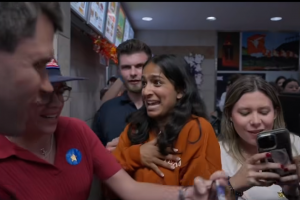
“These are our places; these are experiences we share,” said Texas food historian and cookbook author Melissa Guerra. / From YouTube
“Of course, it’s better than In-N-Out,” Talarico said in one video, taking a playful dig at the California burger chain and reaffirming his Texas pride.
These food stops are more than just everyday locations; to Texans, they are cherished local landmarks.
“That’s really where our community comes together,” Texas food historian and cookbook author Melissa Guerra said about Whataburger, H-E-B and Buc-ee’s.
“These are our places; these are experiences we share.”
Guerra said these businesses share deep Texas roots and have grown alongside the various stages of the Lone Star State’s evolution. H-E-B was founded in 1905 in Kerrville; Whataburger, with its Texas-size burger, originated in Corpus Christi in 1950; and Buc-ee’s, along with its Beaver Nuggets, opened its supersized gas station doors in Lake Jackson in 1982.
“These are brands that invested heavily in Texas when the rest of the United States was investing in New York and California,” Guerra said.
The political use of everyday, popular food locations that may appeal to voters is not new.
“There’s always been this idea of contact connecting with voters through food,” Guerra said.
In the 2000 presidential race, Laura Bush won the First Lady Bake-Off, a political baking competition created by “Family Circle Magazine,” with her Texas Governor’s House Cowboy cookies against Tipper Gore’s gingersnaps. She shared the recipe with her constituents and helped her husband win the popular vote.
More recently, Donald Trump visited a McDonald’s in Pennsylvania during the 2024 presidential campaign, where he served fries to voters in the drive-through.
“You’re not really knocking on their door, you’re knocking on their stomach,” Guerra said, adding that blending politics and food speaks to a visceral human desire for abundance and fulfillment.
When food is a test of authenticity, a misstep can turn into a political embarrassment. Texans still remember the shock of witnessing President Gerald Ford eat a tamale with the husk during his 1976 Alamo visit, which became known as the “Great Tamales Incident.”
“It was such a disconnect,” Guerra said. “It was a big sign that he did not understand us.”
Politicians are trying to reach younger audiences with social media, said Mark Strama, a communication professor at UT and director of the Annette Strauss Institute for Civic Life.
In 2018, Democratic Senate nominee Beto O’Rourke made a Facebook Live while skateboarding in a Whataburger parking lot at night.
“I remember it being very viral on social media,” Strama said. “It’s one of the prominent examples of politicians in Texas trying to associate themselves with a beloved local brand.”
Social media allows political candidates to use brands in ways traditional television ads cannot, since they would not get brand permission, Strama said.
With 2.6 million Instagram followers, Talarico has relied heavily on social media to advance his political brand, Strama said. Paxton has 54,900 Instagram followers.
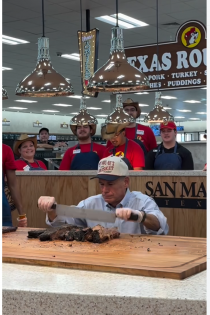
Gov. Greg Abbott also shared a video on social media cutting a giant piece of meat at Buc-ee’s in August, showing that leveraging iconic Texas food culture is a bipartisan strategy.
“I think any politician in Texas would love to be associated with brands like Whataburger and H-E-B,” said Strama, a former member of the Texas House of Representatives.
But these brands prefer to remain apolitical and may not approve of politicians’ surprise visits.
“We’re proud to give Texans across the political spectrum something they can agree on — their love for Whataburger. We don’t endorse candidates; we do support serving great food to our customers no matter how they vote or how they like their burger,” a Whataburger spokesperson wrote.
In a statement, an H-E-B spokesperson wrote that the store was unaware of Talarico’s visit before it happened, and added that the brand does not endorse political candidates.
Even though political candidates try to associate themselves with popular brands in their messaging, Strama said he does not think it determines their success.
“It’s much more important to have a message and to be able to get your message out,” Strama said.