Hill Country Residents Are Worried About a New Wastewater Treatment Facility. Experts Say It’s Complicated.
By Max Mazoch
Reporting Texas
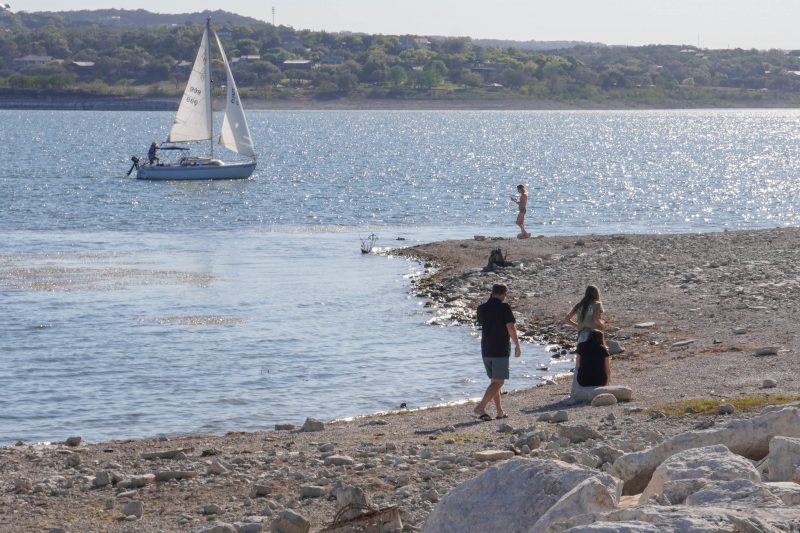
Hill Country residents opposing a new wastewater treatment permit for the Broken Cedar Ranch development worry that Canyon Lake and other waterways could be polluted if something goes wrong. Max Mazoch/Reporting Texas
Whitney Lauderdale has loved the beauty of the Texas Hill Country for as long as she can remember. It was the place that captured the heart of her grandfather, who purchased the 28-acre Comal County property Lauderdale lives on, and one that she hopes to pass to her two children.
“This is where we plan on spending our forever,” Lauderdale said.
It’s idyllic. But Lauderdale worries it may not be in years to come.
In the past year, Comal County residents were shocked to learn a new permit for a wastewater treatment facility had been proposed for a development in Fischer in the northern part of the county. If approved, the facility would discharge 600,000 gallons of treated wastewater per day into Potters Creek, which flows into nearby Canyon Lake — a regional drinking water supply and a significant tourist attraction.
While water resource experts argue that the facility is not unusually large and that chances of contamination are low, residents say they are concerned that the treated wastewater will taint the water quality of Canyon Lake and that these facilities could become increasingly common as the once-rural region continues to develop.
Broken Cedar Ranch is one of many new developments in booming Comal County between Austin and San Antonio. The county ranked second amongst the fastest-growing U.S counties with a population over 100,000 according to the San Antonio Report.
“The rate of growth is just absolutely crazy,” said Annalisa Peace, executive director of the Greater Edwards Aquifer Alliance.
Lennar Homes, the developer, has several developments planned or constructed throughout the county, including 850 homes on the 230 acres purchased for Broken Cedar Ranch. The company declined requests for an interview.
Lauderdale helps run the nonprofit Fischer Texas Neighbors, a group advocating for “responsible growth” in the Hill Country.
She said she’s concerned the pollutants in treated wastewater discharge, otherwise known as effluent – which can include E. coli, solid particles and the toxic compounds known as “forever chemicals” – could make Canyon Lake’s drinking water supply unsafe for the cities it serves.
“It’s not just Canyon Lake and Fischer residents who would be impacted,” Lauderdale said. “Blanco, San Marcos, San Antonio and New Braunfels — that water is coming from Canyon Lake.”
Lauderdale said residents also worry the wastewater discharge will enter the Trinity Aquifer, posing a threat to the 56 personal groundwater wells that rely on it for household uses.
The potential wastewater discharge could also carry nitrogen and phosphorus, which in high levels, can cause algal blooms that depletes water of oxygen and causes fish kills, Peace said.
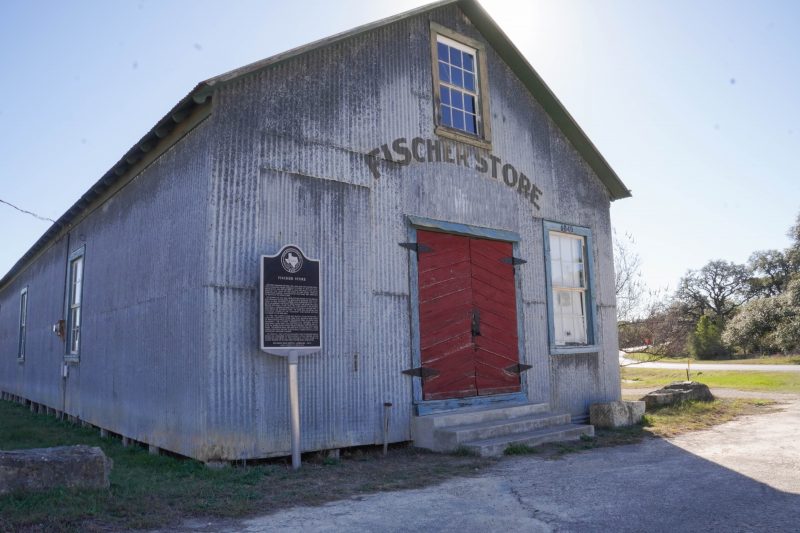
The century-old Fischer Store is a landmark near where developers are seeking a wastewater treatment permit for their 850-home development in Comal County. Max Mazoch/Reporting Texas
The worries were aired Feb. 10, when hundreds of people brought their concerns to the Texas Commission on Environmental Quality, the state’s environmental regulatory agency, during a public hearing at Canyon Lake High School, according to the San Antonio Express-News.
“I’d bet my farm there’s not a person sitting up here that’s going to be drinking this water,” one opponent of the plan, Jerry Wood, was quoted as saying in the Express-News report.
But water resource experts argue people shouldn’t worry.
The potential pollutants listed in the proposed permit aren’t unique compared with other wastewater treatment facilities, said Keisuke Ikehata, a professor of wastewater engineering at Texas State University.
Wastewater treatment facilities routinely discharge treated effluent into waterways across the entire United States.
Ikehata said that the proposed 600,000 gallons of wastewater per day is a “relatively small amount from a municipal wastewater management standpoint.”
“Instantaneoulsy, these constituents will be diluted and become smaller concentrations as it pours in and combines,” Ikehata said.
The proposed wastewater treatment facility is even cleaner than most, he said; it uses an advanced filtration process called a membrane bioreactor (MBR). The process uses a membrane with small openings to remove E.coli and other organic matter to ensure the discharge will be safe.
Ikehata said MBR facilities produce treated effluent with “less organics, less nutrients and less pathogens at the end” compared with conventional wastewater treatment facilities that use a sand filter.
Nearby San Marcos has a wastewater treatment plan that discharges 5 million to 6 million gallons of treated wastewater per day into the San Marcos River using a conventional plant, Ikehata said. Despite this,the river is still known for its water quality and maintains its tourism economy.
“As long as the developer works with the proper wastewater engineers who can design and construct a good system,” Ikehata said. “It should not cause a major environmental deterioration.”
The discharged wastewater is also unlikely to significantly affect the Trinity Aquifer’s water quality, said John Sharp, an emeritus professor of hydrogeology at the University of Texas.
The Trinity Aquifer, which sits below Potters Creek and Canyon Lake, is a karst system made up of a network of caverns and fissures that store water after it seeps beneath the surface. Sharp said this means water from the surface will enter into the aquifer, though its patterns can be unpredictable.
If issues do arise, groundwater wells close to Potters Creek could see effects, but they would likely be minimal, Sharp said.
“I can see why people have a right to feel concerned,” Sharp said. But “in theory, if it is done well, there should be minimal concerns.”
Still, Peace is not convinced.
Peace said “in isolation,” the Broken Cedar Ranch wastewater facility may not have significant impacts, but she is concerned about the increasing number of permits discharging into Canyon Lake.
“If you look at the cumulative impacts, especially with the lack of rainfall we’ve had, you’re going to have a higher and higher percentage of water that’s in the lake being sewage effluent rather than rainfall,” Peace said.
Peace and Lauderdale also have concerns about the developer, Lennar Homes.
Lennar Homes has a past of violating environmental regulations, Peace said. In 2019, the GEAA and neighboring homeowners sued Lennar, arguing the developer broke a 2016 settlement agreement with the GEAA to protect Edwards Aquifer recharge features located on the property and build stormwater runoff prevention measures in a new development construction.
Peace said Lennar Homes built a home on top of an aquifer recharge feature, a fracture or cave that allows water to seep into the aquifer. Blocking a feature could potentially prevent water from the nearby area from refilling the aquifer, though aquifers have many recharge points.
Peace also said the developer placed stormwater drain discharge points in locations different than what was agreed upon in the GEAA settlement agreement. Because of the location, Peace said, several homes neighboring the new construction were flooded with nearly three feet of muddy water during a storm.
Lennar Homes agreed to a monetary settlement with the GEAA following the lawsuit.
The developer has not announced the wastewater treatment facility’s operator, Lauderdale said, a crucial role in ensuring the facility’s safe management.
The wastewater treatment facility must have at “least one or two operators” there at all times to make sure the plant’s systems are running as designed, Ikehata said. The operating entity can be either a private company or public utility, and individual operator licences can be classified in different classes depending on their qualification and work history.
Peace said the GEAA typically asks developers to use Class A operators – the highest tier.
Rural areas also can present challenges for operating a wastewater treatment facility because of “limited manpower,” Ikehata said.
“Things can go wrong if they don’t have enough resources to run the facility,” Ikehata said. “For a smaller facility, this is certainly challenging.”
The final decision on the permit will take some time.
Before a decision is made, the TCEQ must review and reply to the 1,278 comments submitted as a part of the agency’s public comment process required by the state.
Sharp said he understands the residents’ concerns with the wastewater treatment plant and rapid development, but disagreed with their attempt to stop it.
“If I was living there, I would like to limit development because I like that rural setting.” Sharp said. “But people have the legal rights … to develop it. And if there’s going to be development, you have to have really good sewage treatment plants.”