For Parents and Kids, Miracle League Builds Community on the Field and Off
By Isabella Schultz
Photography By Isabella Schultz
Reporting Texas
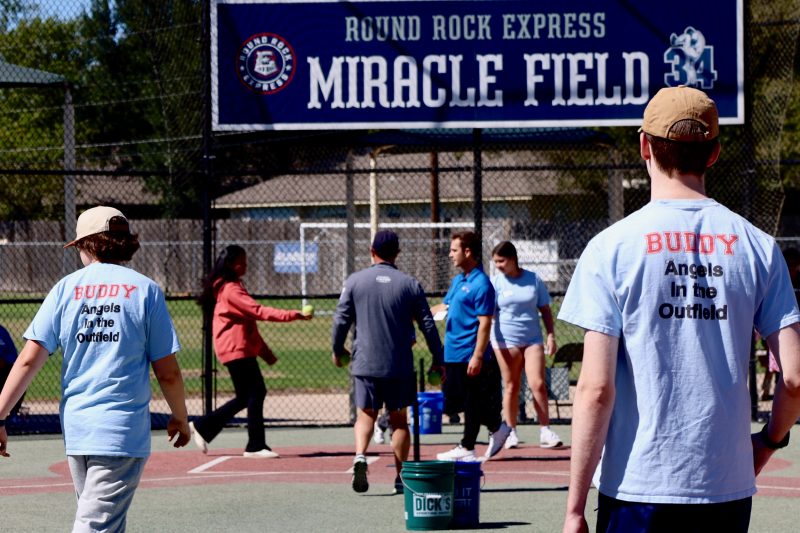
The Miracle League’s ‘buddies’ are middle school and high school students who help the players with disabilities throughout their games. Isabella Schultz/Reporting Texas
Twenty years ago, Tracey Brown and her husband, Steve, opened Austin’s first-ever Miracle League branch.
The Miracle League is a nonprofit sports organization that caters to the needs of those with cognitive and physical disabilities. Participants say it provides them with a sense of community while playing America’s pastime, baseball.
The Browns do not have children with disabilities of their own, and they said they had not realized what Central Texas was missing.
“What we didn’t understand was the impact it would have on parents,” Brown said. “Being the parents of healthy children, we took for granted sitting on the sidelines, eating popcorn.”
Before the start of the Austin group, Steve was watching the show “Real Sports” on HBO, where an episode talked about the National Miracle League, which started in Georgia.
“One of the things he noticed was, when you go into any of the entrances at Town & Country, the youth sports organization in Northwest Austin, it says ‘serves all youth,’” Tracey Brown said. “And then he said, you know… They don’t serve all youth, because there’s a whole group that we don’t even recognize that don’t have the opportunity to play.”
The Miracle League has since had an impact not only on the players, but on neurotypical volunteers and parents as well.
The volunteers, “the buddies,” are middle school and high school students who help the players by their side throughout the games. This allows parents to watch their child play rather than assisting them on the field.
“What we didn’t understand was the impact it would have on parents,” Brown said. “Being the parents of healthy children, we took for granted sitting on the sidelines, eating popcorn… so that buddy program allows the parents to be in the stands, cheer, take pictures and network.”
The league is made up of 10 teams named after Major League Baseball teams, such as the New York Yankees and the Detroit Tigers.
To play on the teams, each player pays a $25 registration fee for play, a hat and a jersey. They also encourage donations, as they want to keep the registration fee as low as possible so all players can play regardless of finances.
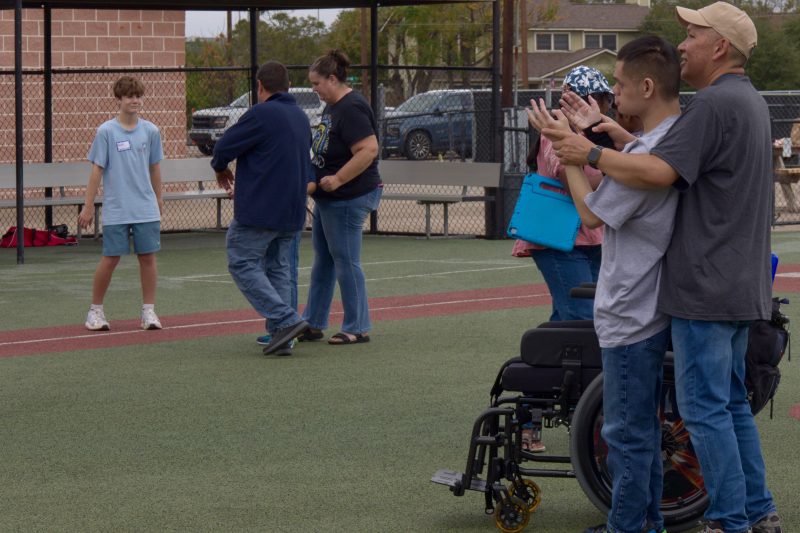
Paul Luke claps with his son Kamalani while dancing the Chicken Dance. Isabella Schultz/Reporting Texas
Team Yankees coach Paul Luke has been involved with the Austin Miracle League for nearly 19 years. His son Kamalani has cerebral palsy and is a former player of the league. For Luke, the Miracle League was a way for his son to feel part of a group.
“When Kamalani was little, it used to break my heart because he used to go to like daycare, and I would see him like when I came to pick him up, he was always sitting on the side, you know, and watching all the other kids run around and having fun. That’s the reason why I support them so much,” Luke said. “They’re giving the kids with disabilities a chance to play.”
Kamalani, now 26, has retired from playing and now helps with physical and speech therapy programs at Texas State University and co-coaches Team Yankees. For his dad, the Miracle League is still a weekly opportunity to connect with parents experiencing similar things he and Kamalani went through.
The Miracle League has also helped parents form friendships beyond the field.
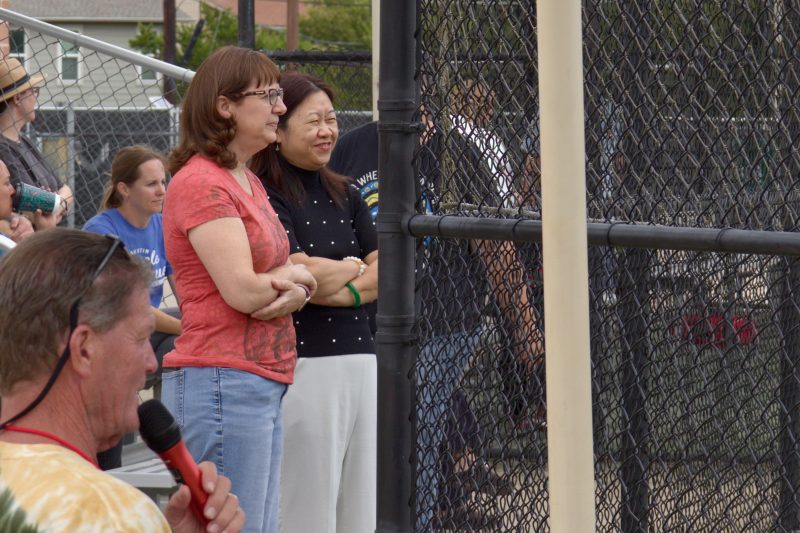
Jennifer Stoutenburg, center, and Irene Xie watch their sons Andrew and Evan as they head to the batter’s box. Isabella Schultz/Reporting Texas
Irene Xie and Jennifer Stoutenburg are the parents of two New York Yankees players, Evan and Andrew. The two parents met at the Austin Miracle League, and their sons have been friends ever since.
“For our family, we don’t really have a lot friends because the kids, and this has become like a connection, a social way to meet other families in the same boat,” Xie said.
Parents Paul Johnson and Tommy Smyrski say they, too, look forward to their weekend plans at the Miracle League, just as their daughters and Team Tigers players Megan and Estella do.
Johnson and Smyrski believe that as parents, it is their connections that enrich them, and that the league’s environment feeds them at the root.
Programs like the Miracle League can help kids and their parents feel less alone, said Andrew Colombo-Dougovito, an associate professor at the University of North Texas.
Colombo-Dougovito specializes in special physical education, and through his research, he has studied how those with autism move differently.
“They also get to find tips from other parents. … They get to see what other parents and families are doing and go ‘wow, hey, that’s something that worked for them. Maybe we should try that over here,’ and you kind of get to trade secrets back and forth, and that way, you’re just not so isolated,” Colombo-Dougovito said.
Tracey Brown hopes that this league can have a lasting effect not only on the players, but for those around them.
“The very fact that these kiddos are out here playing, and the buddies are learning, and the parents are laughing, and that, in itself, is a miracle,” Brown said. “We just don’t recognize them very often.”