For Drag Performers, Court Ruling Brings Fears of Enforcement of Restrictive New Law
By Erika González
Reporting Texas
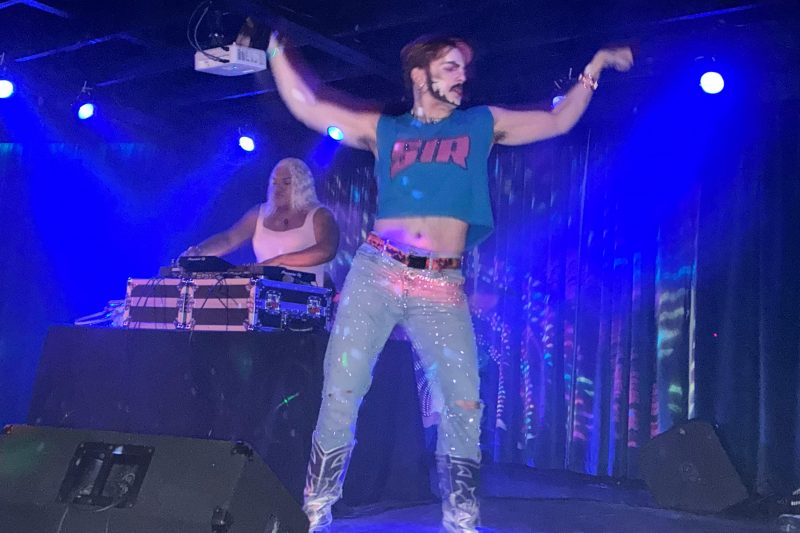
Sir Maxim performs at 29th Street Ballroom in Austin in December. As a drag king, he is worried about enforcement of a Texas law restricting drag performances after a court recently upheld the law. Erika González/Reporting Texas
The stage glowed under colorful lights as drag king Sir Maxim prepared to step out. His hands shook slightly, he said, not from fear but from the weight of the moment: years of exploration, identity and creativity distilled into a few minutes onstage.
As a drag king, Maxim performs masculinity through exaggerated male persona, with shows centered on satire and comedy.
“Watching drag helped me realize I could create my own rules, my own definitions of gender, masculinity and what drag can be,” Maxim said, recalling his first performance in Austin in 2022.
That same stage, once a place of self-discovery, is now a place of uncertainty.
On Nov. 6, the 5th U.S. Circuit Court of Appeals allowed Texas to enforce Senate Bill 12, a law passed in 2023 that restricts certain drag performances deemed “sexually explicit,” particularly those held in public spaces or in the presence of minors. Venues face fines of up to $10,000, while organizers or performers could be charged with misdemeanors.
While not all shows are directly affected, the law has created an atmosphere of concern that weighs on Austin’s drag community. According to the American Civil Liberties Union, the Texas Legislature led the nation by considering 80 anti-LGBTQ bills this year, part of 527 similar proposals across the United States.
“Even saying that I do drag is something I think twice about now, at work, at family events, walking around the city,” Maxim said. “I don’t know who might see me as a ‘villain’ or a ‘pervert.’ ”
Texas’ New Legal Framework for Performances
The renewed enforcement of SB 12 comes amid a broader social and legal context. The Gay and Lesbian Alliance Against Defamation reported 61 anti-LGBTQ incidents in Texas between May 2024 and May 2025, including bomb threats and physical assaults.
SB 12 prohibits performances defined as “sexually explicit” in public spaces or in front of minors. The law bans performers from using sexual prosthetics, simulating sexual acts or engaging in performances that could be interpreted as having a “prurient interest.” It also penalizes the exposure of “intimate parts” covered by tight clothing or prosthetic padding that creates a sexualized appearance.
Although the law does not explicitly mention drag, organizations such as Equality Texas say its language is aimed directly at the drag community. The statute includes terms like “gender caricaturization” and “sensual performances,” categories broad enough to allow subjective interpretation.
“The problem is that it leaves room for someone to label a drag show as inappropriate even if there is no sexual content,” Equality Texas said in a public statement.
The ACLU has also questioned the scope of the law, arguing that terms such as “sexual conduct” and “prurient interest” are not clearly defined in the statute.
That ambiguity has been one of the central arguments in legal challenges surrounding SB 12 since its passage. Attempts to contact Sen. Bryan Hughes, the bill’s author, for comment on the law’s intent were unsuccessful.
“The language is so subjective that it could apply to theater, cultural events or even educational performances,” said Trey Devine, an Austin based drag king. “It’s a direct attack on drag.”
Angelo Ríos, showrunner of Draggieland, an annual event in College Station, said the fear extends beyond performers to the venues that host shows.
“Many businesses that used to book performances no longer want to take the risk,” Ríos said. “This law creates self-censorship and affects real income.”
While some private events continue, the legislation makes clear that any performance visible to the public could be scrutinized.
Maxim summed it up with a simple example: a tight costume, an energetic dance move or an improvised joke can be perceived as a risk. That possibility, several artists said, is enough to make audiences and venues more cautious about attending or booking shows.
“There are movements that used to be part of my character that I now avoid,” Maxim said. “Not because they’re inappropriate, but because they could be interpreted as something they’re not.”
Gigi Supernova, a drag performer with seven years of experience in Austin, said she has begun working with a more rigid script.
“I used to improvise a lot. Now I have to review everything twice, change songs, change choreography, change jokes,” Gigi said.
Both artists said these adjustments have altered the atmosphere of drag shows. Where once was noise, shouting and high energy, there is now a more restrained attentiveness. Several performers described audiences watching quietly, as if also evaluating what is “safe” to celebrate.
Attendance fluctuates, artists said, depending on the political climate and rumors about possible inspections, which performers said have discouraged some audience members despite no penalties under the law for attendees.
“It’s frustrating that a simple misunderstanding can affect my job, my drag family and even my work outside of drag,” Maxim said. “Attendance drops because of fear and stigma more than the law itself.”
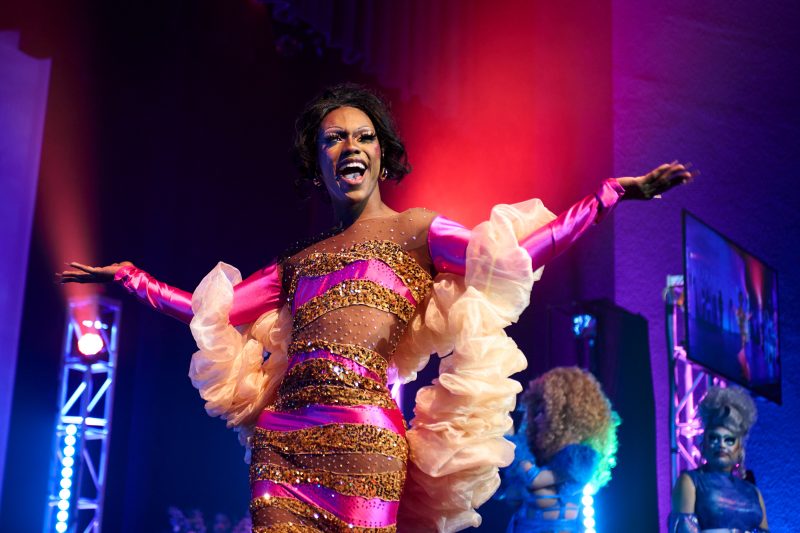
Draggieland contestant Maria Maria strides across the stage during this year’s show at Texas A&M. Shunya Carroll/Reporting Texas
Draggieland: Building Community as the Rules Change
Amid the restrictions, some projects are working to preserve safe spaces for drag. One of them is Draggieland, a collective based at Texas A&M University that combines workshops, mentorship and performances with a focus on community and training.
Draggieland was created as an adults-only space for emerging performers and audiences seeking a safer environment. The project includes workshops, photo sessions, makeup guidance and 18+ shows, allowing it to operate without uncertainty about the presence of minors.
Draggieland survived an attempt by the Texas A&M University System to shut it down in the spring, thanks to a federal judge’s ruling.
The group now functions as a support network within the community, organizing events in private spaces and offering guidance on how to navigate SB 12 while continuing to work.
“What we want is for people to keep coming, not to be afraid,” Ríos said. To do that, organizers have implemented strict rules, including routine reviews, time restrictions, venue agreements and volunteers who monitor performances to prevent misinterpretation.
Even so, the changes are noticeable. Some attendees choose not to bring their families, while others prefer smaller or lower profile events. Each gathering now requires additional planning, from contract reviews to clearly marked exits to avoid conflicts.
‘They Won’t Silence Us’
Despite the challenges, the drag community in Texas continues to endure. Maxim pointed to the strength that comes from collective support.
“Sometimes having a common enemy brings people together,” Maxim said. “That gives you strength.”
Gigi agreed, saying collaboration is key to the scene’s future. “If we supported each other and helped each other grow, drag in Austin would be stronger and something to be proud of,” she said.
Ríos said that even with restrictions, private and student-based shows will continue, and the community is learning how to balance visibility with safety.
“It’s going to complicate things, but they won’t make us disappear,” Devine said. “Drag is a form of existence, expression and community. They won’t silence us.”
Between uncertainty and adaptation, performers said unity and creativity are what allow the scene to keep growing.
“The more of us there are, the more the scene will grow,” Maxim said. “If we focus on joy, humor and community, that energy can spread across Texas. I just hope drag kings don’t give up. There is greatness in our future.”