DACA Helped Them Get Legal Commercial Vehicle Licenses. A New Policy Took Them Away.
By Erika González
Photography By Erika González
Reporting Texas
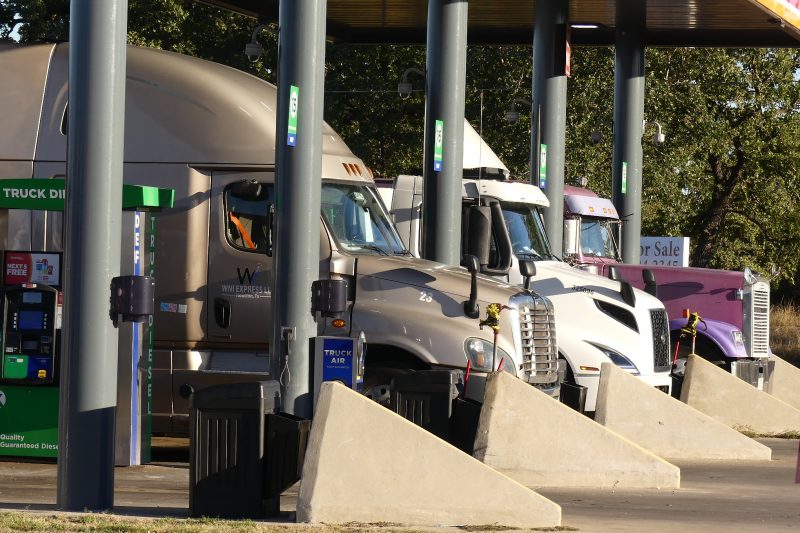
Trucks refueling at the outskirts of Houston. Erika González/Reporting Texas
At 4 a.m., Yeni Renderos’ alarm went off, just like every other day. Half-asleep, she made coffee, woke her 16-year-old daughter and drove her to school before climbing into her truck, “Rosendo,” as she affectionately called it. For 10 years, that routine had defined her life in Houston, driving to construction sites, convinced her life was finally moving forward.
But that Monday was different. Renderos’ boss called to confirm what she feared most: “You can’t keep working, Yeni, she recalled him saying. “The rules for commercial licenses have changed.”
In seconds, the truck that symbolized her independence came to a stop, and the life she had built mile by mile began to fall apart.
“I froze,” the 43-year-old Renderos said. “For many people, it’s just a truck. For me, it was my partner in life and my livelihood.”

Yeni Renderos in her truck, ‘Rosendo.’ Erika González/Reporting Texas
Renderos is one of thousands of non-citizen truckers on the verge of losing their livelihoods after the state of Texas announced new restrictions on commercial driver’s licenses for immigrants. State officials say the change is meant to improve safety, but it comes amid a broader national crackdown on immigrants and it threatens to sideline a workforce that plays a vital role in keeping Texas’ economy moving.
Texas has issued more than 3.2 million CDL licenses since 2015, including 51,993 for non-domiciled drivers. Just in 2024, 6,265 licenses were granted to non-citizens, the highest number in the country, according to Overdrive, an industry publication.
Renderos was born in El Salvador and came to the United States when she was 6 years old to reunite with her parents in Los Angeles. They had emigrated in 1984 in search of a more stable future. Over time, she grew to love California and the American way of life.
In 2011, when she first heard about Deferred Action for Childhood Arrivals, the policy created by former President Barack Obama to protect young undocumented immigrants from deportation, she felt that, at last, the country she considered home was opening its doors.
“It was like a miracle from the sky,” she said.
With that DACA permit, she began to work legally. She chose construction, a field she describes as “unusual for women but a show of Salvadoran strength.” She got her commercial driver’s license without trouble and began to drive heavy trucks.
In search of better opportunities, she moved to Houston in 2014. There, she began a new chapter as a dump truck driver, proud of her trade and of the years she had spent supporting her family through it.
This year, she was about to celebrate a decade with the same company. But by the end of September, her license stopped working after the Texas Department of Public Safety suspended the renewal of commercial licenses for certain immigrant groups, including DACA recipients, refugees and asylees.
The measure left Renderos off the road and without income.
A DPS document projects that as many as 194,000 current CDL holders could be pushed out of the trucking workforce.
The initiative is part of the department’s commitment to highway safety, according to a DPS statement,
A spokesman for the Texas Department of Safety declined to speak about Texas’ action.
The department’s Sept. 29 clampdown on non-domiciled licenses did not cite any incidents on Texas highways or data regarding the safety of those drivers. The DPS announcement said the agency was acting in response to a similar action by the Federal Motor Carrier Safety Administration, which cited a “recent series of horrific, fatal crashes caused by non-domiciled drivers.”
One of the fatal wrecks listed by the federal agency occurred March 14, 2025, in Austin, when a tractor-trailer driver failed to brake, triggering a 17-vehicle crash on Interstate 35 that killed five people, including two children, and injured 11 others.
Investigators found the driver had improperly received a standard commercial driver’s license instead of a non-domiciled one, did not have a valid medical certificate and violated hours-of-service rules.
John Esparza, president and CEO of the Texas Trucking Association, said the measure could have major economic implications for the industry.
“For decades, immigrants have helped fill the driver shortage in Texas and across the country,” Esparza said. “If this policy limits who can obtain a commercial license, it could slow deliveries, raise transportation costs and strain supply chains, especially in Texas, one of the largest freight markets in the world.”
Esparza said the suspension will temporarily affect hundreds of workers, but the trucking industry expects to adapt as regulatory changes are studied to allow affected drivers to return to work.
Still, he said safety remains a priority.
“We can’t compromise on safety standards,” Esparza said. “But there’s no denying that removing qualified drivers from the workforce will affect the economy.”
DACA: A key force in Texas’s economy
Texas is home to the second-largest population of DACA recipients in the country, with 154,160 active beneficiaries, 17% of the national total, according to the U.S. Citizenship and Immigration Services. Many of them work in essential sectors like construction, transportation and energy.
Data from the American Immigration Council shows that refugees make up 1.2% of truck drivers in Texas, while DACA recipients account for around 1.1%.
Nationally, households with DACA recipients contribute over $6.2 billion in federal taxes and $3.3 billion in state and local taxes each year, according to the Center for American Progress.
“When I finally got it, they took it away”
Like Renderos, Ricardo Martínez, a Mexican immigrant raised in Texas since he was 6 months old, has also been affected by the new rules.
Martínez lives in Houston but works between Midland in West Texas, and Carlsbad in eastern New Mexico, operating cranes in the oil industry, a job that requires a CDL.
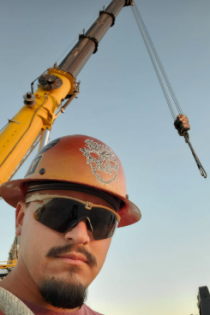
Ricardo Martínez, a crane operator, spent thousands of dollars on training for a license he now must give up.
“I finally got my CDL in July after spending $6,000 on school and fees,” he said. “I’ve been in the business for five years, and not having a license always made things harder. When I finally got it, they took it away.”
Although he still has his job, his position has become unstable. His boss warned him that he’ll need to find something else soon, since the route he works on requires a valid commercial license.
“I’m still working because operators are still needed, but driving is complicated now,” he said.
Faced with this situation, Martinez sums up his frustration: “What’s the point of giving us DACA if they’re just going to leave us empty handed, with no way to work?”
The future of DACA: Reinventing life after losing a CDL
For Renderos, the suspension means a complete change in her career. After 10 years supporting her family with her truck, she said she now has to find a new path.
“My mind can’t stop, not just for me, but for my family,” she said.
She’s considering teaching Spanish in Texas or even moving to another state.
“We kind of knew this was coming,” she adds, referring to the new policy. She called it “a way to show what we’re really made of.”
Caring for her 16-year-old daughter makes the challenge even harder, but she’s willing to learn new skills and temporarily leave behind the dream she fought so long to build.
For Martínez, the road ahead is also uncertain. “I don’t have a clear plan yet. I just hope new rules come out that help us,” he said “ I came here for a dream. I grew up here, and this won’t stop me.”