Brazilian Funk, World Music’s New Darling, Hits Austin Clubs
By Oisakhose Aghomo
Photography By Oisakhose Aghomo
Reporting Texas
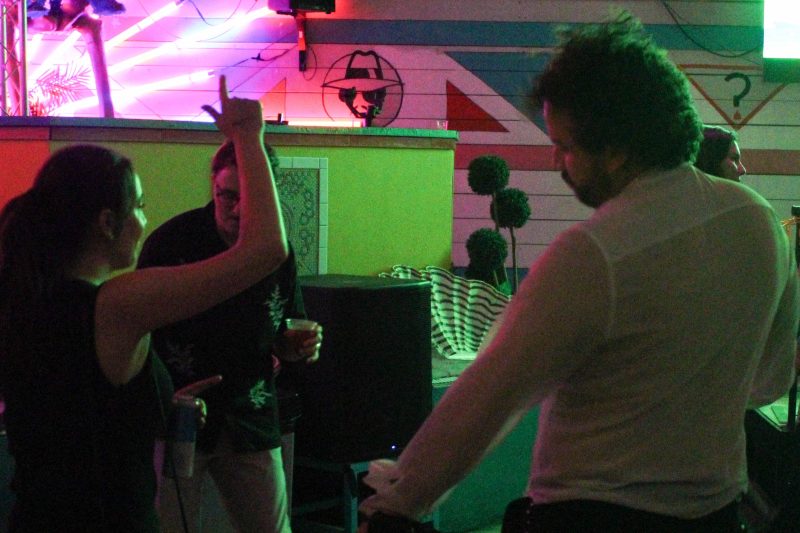
Partygoers dance as DJ Ray All Day plays Brazilian Funk at Coconut Club. Oisakhose Aghomo/Reporting Texas
Sometime close to midnight, as the bass to MC Joao’s “Baile de Favela” dropped, a group of people in business casual hurried across the Coconut Club’s dance floor, drinks in hand, to dance — hooked by the electric beat of Brazilian funk.
Brazilian funk is the latest Latin genre breaking out from TikToks and into the clubs – a testament to Americans’ growing interest in global music.
“I’ve been DJ’ing for maybe 12 plus years here on Sixth Street, and man, like 10 years ago, it was nothing but hip-hop and like pop, Top 40,” said Austin DJ Ray “All Day Ray” Rivera. “You couldn’t play much Latin. You couldn’t do anything like that.”
Rivera is a longtime Brazilian funk fan. He first heard of the genre through “Piracy Funds Terrorism,” a mixtape by M.I.A.
“Growing up in Texas… even Latinos didn’t know what that was,” he said. “It took Austin a long time to catch up. My escape was going to Houston (to play funk sets).”
Today, in Austin’s party epicenter from Fourth Street to Sixth Street, nightclubs like Coconut Club, Mala Fama and Mala Vida are giving Austinites access to international sounds like Brazilian funk, reggaeton and afrobeats.
“Listening to funk or dancing outside my country is weird to me,” said Denise Braz, a Brazilian doctoral student in Latin American Studies at the University of Texas. “I feel like people who are not Brazilian or not Latin people … can’t understand the lyrics, but they can understand the energy of the funk.”
Brazilian funk was created by Afro-Bbrazilian communities in the favelas, or working class neighborhoods, of Rio de Janeiro around the 1980s. DJs started to experiment with the sounds of American soul, funk and freestyle, also known as Black music. In its beginning, Brazilian funk was characterized by lyrics depicting life in a post-racial democracy that still had race and class issues.
“I like the funk of the 2000s … with beats from Miami bass, because that’s how it originated,” said Austin DJ Anderson Pereira Goes, whose moniker is DJ Sampha.
Pereira Goes is Brazilian and has lived in the United States for 11 years. He said funk has traveled from a niche genre to popular party music that has crossed race, class and geographic bounds.
In 2024, “São Paulo,” a song by funk artist Anitta and The Weeknd, charted at 43 on the U.S. Billboard chart, the highest for a funk artist. This year, funk artist Ludmilla made history as the first Afro-Latina musician to perform at Coachella. Influential American artists like Beyoncé and Kanye West have used funk samples in their most recent albums.
DJs streaming funk sets during the COVID-19 lockdown helped the genre gain a large global digital audience. Social media apps continue to be a space for funk dance trends and sounds to gain popularity.
“I put myself playing a set (on TikTok) and it was a clip of me playing baile funk edits also and I just said, ‘Where are all my Brazilians in Austin?’ It took off and wound up getting like 14,000 or 15,000 views,” said Diego “DJ Diego the Fuego” Rosales.
Social media has also propelled social venues focused on international music into hot spots.
Mala Vida, a popular spot on Sixth Street, brands itself as “Austin’s number one and most viral Latin club,” with more than 51,000 followers on Instagram.
Gabriela Alma Bucio, owner of Mala Vida and Mala Fama, said her intention was to create a space for Latin music so it wasn’t relegated to “the outskirts” of the city.
“Growing up, there weren’t really Latin spaces in the downtown area or at least not run by Latin people,” said Bucio.
Her clubs have received an outpouring of support, especially from the Latin community. However, there have been some challenges.
“Being in downtown, the types of music that we play, we’ve gotten threats from neighboring buildings and not from just the people that live there but from their actual management,” Bucio said.
Bucio stated her frustration is that she maintains her clubs’ sound levels “lawfully just like everybody else in regards to sound.”
In Brazil, bailes, or parties where predominantly funk music is played, tend to be targeted.
In April, Rubinho Nunes, a São Paulo politician known for being anti-funk, pushed the Parliamentary Inquiry Commission to launch an investigation into “clandestine” bailes in the city’s peripheries. He claimed the parties are noisy and created by crime syndicates.
“The favelas, the funk, remind people about the history of slavery, about how these people are living in the favelas, and why the favelas exist right now,” said Braz.
Braz said that while Americans may not understand the message, it’s important for the music to be heard outside of Brazil.
“Brazil has such a strong imagery, even though I would say it’s still very rudimentary in many people’s imaginations… I do think the points that they do know are very positive. I think having that all be all in the same high-energy positive connotation, I don’t think it would be that hard to actually add the music into that,” said Elena Grande, a Brazilian-American student at UT.
The American audience’s interest in the genre indicates a hunger for different types of sound.
“You can definitely tell it’s appreciated, maybe it’s a demand for inclusion, especially with a lot of people that come from different backgrounds that do love these different types of music,” Rosales said.