Austin’s South Asian Candidates Were Forced Into a Game of Identity Politics. They Won.
By Vikram Sundaram
Photography By Vikram Sundaram
Reporting Texas
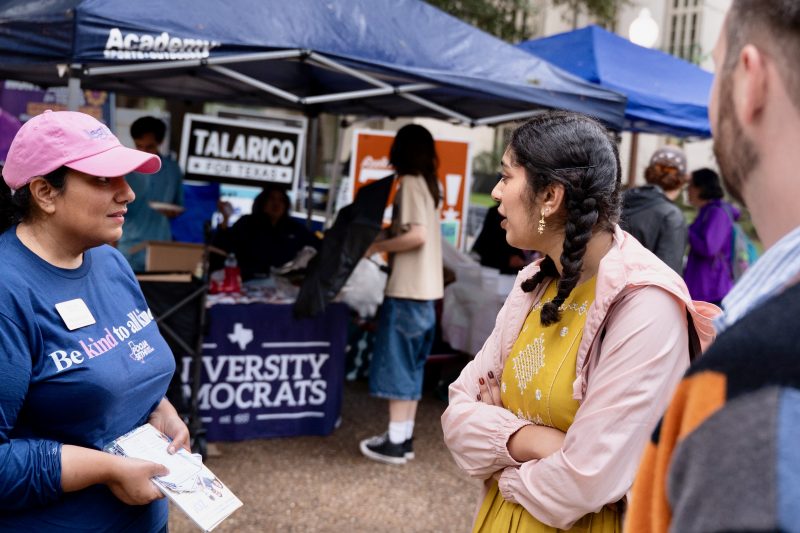
State Rep.-elect Pooja Sethi, left, speaks with UT government major Mira Chary at a campaign event focused on driving South Asian voter turnout on UT Austin’s West Mall. Vikram Sundaram/Reporting Texas
The day after Bo French lost his bid for Texas Railroad Commission to Democrat Jon Rosenthal, French attempted to spin his widely condemned social post targeting South Asian students at a Texas Longhorns football game — one of many flashpoints this election season that turned Texas blue.
“This may be hard for you, but I never mentioned race. The post and the ones leading up to it were about the H1B abuse,” French wrote in response to an X user, referring to his post featuring an image of cheering South Asian Longhorn fans and his pronouncement that “the problem is now obviously far worse than anyone imagined.”
Prominent Republicans like strategist Karl Rove and departing Sen. John Cornyn, R-Texas were quick to condemn French’s comments, but no party leaders directly withdrew their endorsement.
French may be playing coy now about what motivated his posts, but South Austin candidates running for office certainly felt like he was taking aim at their communities.
“Thanks to Bo French, it’s kind of why we all have to step up and talk about why we’re here and why we’re all Texan and why we’re all American,” said Texas House District 47 Rep.-elect Pooja Sethi, an Austin Democrat who defeated Republican candidate Jennifer Mushtaler on election day.
She was one of many South Asian candidates who won Tuesday.
Zo Qadri, who has represented Austin’s District 9 on the City Council since 2023 and was also re-elected, expressed disgust with the rise in prejudice he’s seen from GOP candidates and officials as both a South Asian and Muslim.
“I’m looking forward to being back in office after this election and being a voice for my community,” he said. “I’m also proud of my community for standing up.”
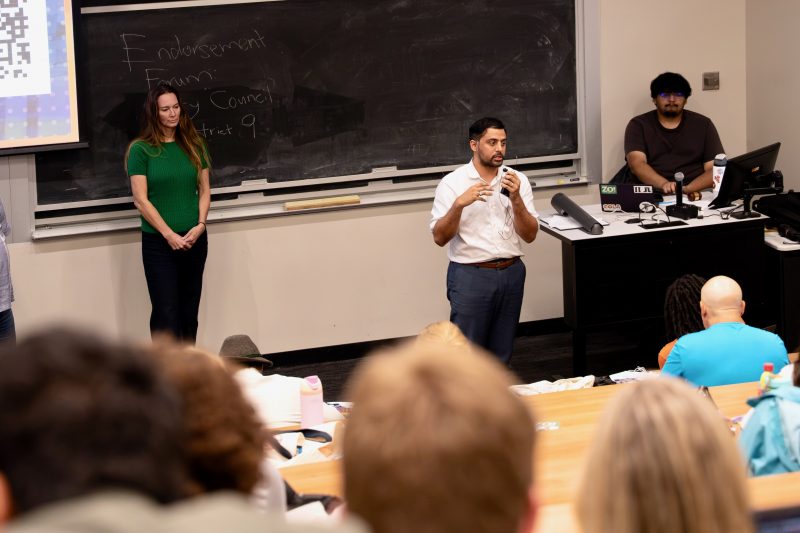
Austin City Council member Zohaib “Zo” Qadri, who represents District 9, makes his pitch to University Democrats during the group’s candidate endorsement forum in September. Qadri is a longtime supporter of the organization and attends most of its meetings because UT is in his district. Vikram Sundaram/Reporting Texas
In recent election cycles, several candidates of color have had to overcome overt enmity from the American right in order to win office. Michigan Sen.-elect Abdul El-Sayed, who defeated Republican Mike Rogers by seven points Tuesday, was pointedly asked during a town hall if he condemned the Muslim Brotherhood, which many perceived to be a dig at his Muslim faith.
A year ago, New York City Mayor Zohran Mamdani was also subject to hateful comments aimed at his faith and ethnicity during his campaign. He defeated his opponent, former New York Gov. Andrew Cuomo, by nearly nine points.
UT government major Mira Chary says she feels inspired when seeing South Asian candidates push through the adversity, especially as she aspires to political service. Chary told Reporting Texas that her family was initially concerned that her aspiration to work in public office would be an unsafe career path.
“For my mom, especially to see a candidate like Pooja, like Zo… makes her feel a little bit more comfortable that I’m going to be OK,” she said.
In Austin, groups focused on South Asian mobilization such as Indian American Impact and SAAVETX are also working to put up stronger barriers against hate. On Oct. 16, Indian American Impact hosted a private listening session at The Clay Pit, a popular Indian restaurant, that featured U.S. Rep. Pramilla Jayapal D-Wash.
“Don’t let anybody tell you that you don’t have the right to seek any career, any office, any opportunity that is in front of you,” Jayapal told a crowd of about 50.
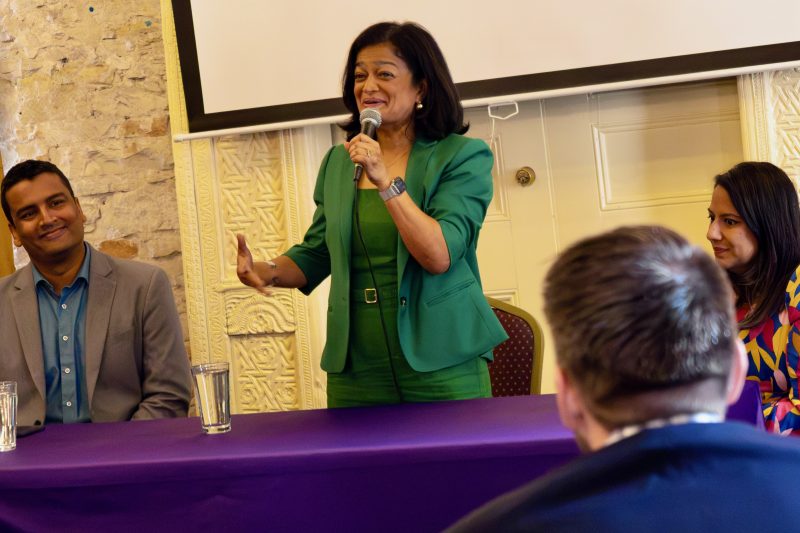
U.S. Rep. Pramila Jayapal, D-Wash., speaks at a listening session for members of Austin’s South Asian community at Clay Pit, a popular Indian restaurant on Guadalupe Street. Vikram Sundaram/Reporting Texas
Jayapal added that recent events centered around hate, like French’s comments and the Oct. 11 attempted mass shooting at a Hindu temple in suburban Chicago, were perpetrated by bigots who fear the power and influence of the South Asian community.
She also pressed the importance of candidates building bridges across cultural divides in her district. “Be who you are, but also be clear about who your constituents are,” she said. “Most of us are not elected by Indian Americans.”
Sumit Dasgupta, a retired semiconductor executive present at the event, shared Jayapal’s sentiments on building bridges, but argued that some animosity his community is facing could be from a lack of perceived involvement in local communities.
“We might give money to build a temple,” Dasgupta said, “A lot of us give back to India. We don’t give back here.”
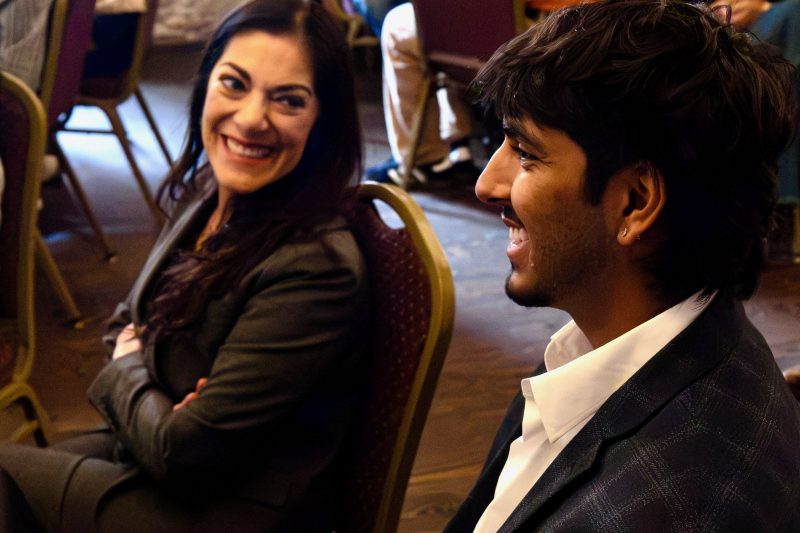
UT student Adrian Neal Gonzales-Dholakia, right, attends a listening session with his mother, Austin Community College trustee-elect Gloria Gonzales-Dholakia, left, at Clay Pit in Austin, Texas, Oct. 16, 2026. Speakers included U.S. Rep. Pramila Jayapal, D-Wash.; state Rep.-elect Pooja Sethi; and Austin City Council member Zo Qadri. Vikram Sundaram/Reporting Texas
Also present at the event was UT Student Adrian Neal Gonzales-Dholakia, whose mother Gloria Gonzales-Dholakia was elected to the Austin Community College Board of Trustees Tuesday.
He argued that there was a shared responsibility among voters and candidates to advocate for change.
“We can’t just be taking pictures with these politicians,” he said. “We have to be out there for them.”
UT finance major Ruchir Kasarla, one of the students caught in the crosshairs of French’s original post on X, was barely roiled by French’s tactics.
“Why would I vote for someone that necessarily doesn’t want me to be here?” Kasarla said, adding that his experience as a UT student has been “extremely welcoming.”
Though French lost his race, his campaign tactics raise larger questions about the GOPs long-term strategy as both parties gear up for the 2028 general election.
When faced with backlash, “leaders of parties will distance themselves from an official involved in scandal if the continued association is politically harmful, or if that person is easy to replace,” says Brandon Rottinghaus, a political science professor and expert on scandal from the University of Houston.
“Republicans were willing to disassociate themselves from French,” he said, when speaking to why party leaders didn’t seek to pull French’s candidacy. “The damage had been done.”
After Texas Railroad Commissioner-elect Rosenthal declared his victory on Tuesday night he said Texans are done with “the politics of division and hate.”