An Amateur Nutcracker Takes the Stage as Student Interest in Ballet Grows
By Saile Aranda
Photography By Saile Aranda
Reporting Texas
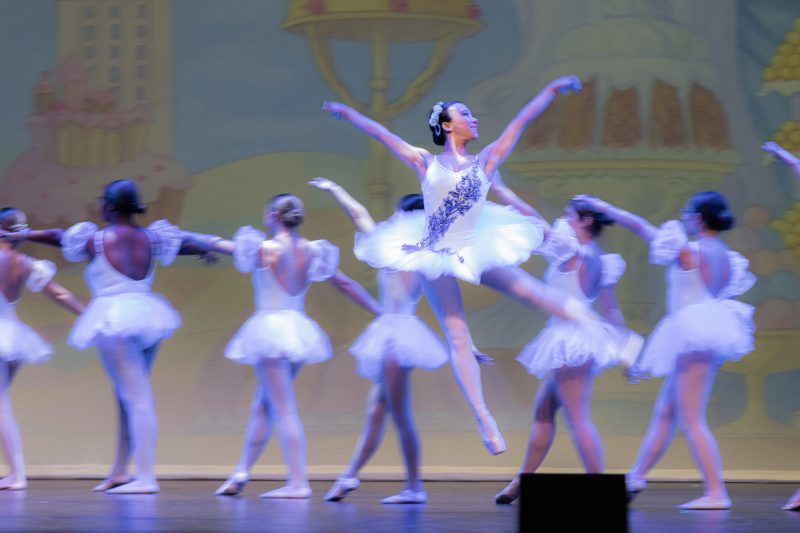
Dancers perform The Nutcracker at Hogg Auditorium for the end-of-semester showcase on Nov. 14. Saile Aranda/Reporting Texas
The melody of The Nutcracker’s opening piece, “Miniature Overture” by Tchaikovsky, fills Hogg Auditorium at the University of Texas as the audience makes its way inside for a holiday classic.
Eight-seven student dancers of all skill levels rush around backstage adjusting costumes, securing headpieces and squeezing in last-minute stretches before kicking off this student-led version of “The Nutcracker.”
For the Texas Ballet Club, this end-of-semester performance has transformed months of rehearsals into an evening of ballet by student dancers and backstage workers on Nov. 14.
“Whether you’ve never danced a day in your life or if you’ve been dancing for years and would like to continue, I hope to provide an opportunity for everyone to be able to experience ballet.” said Texas Ballet’s president, Alex Passmore.
The club, a student-run organization that operates separately from the theater and dance programs in the College of Fine Arts, has noticed an increase in participation from students in the last few years. In 2019, its “Nutcracker” was performed by just 10 dancers, one-eighth the size of this year’s company.
And the club has improved its production values. Passmore said a newly formed a props and costumes committee designed and created every outfit worn on stage, ensuring that each look complemented the overall vision and artistic direction of the production.
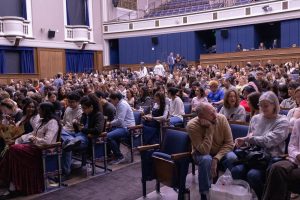
Some 600 people came to Hogg Auditorium for the performance. Saile Aranda/Reporting Texas
Passmore said the club aims to make ballet more accessible.
Students do not have to pay any fees, and its weekly classes are open to everyone, no matter the gender or level of experience. The club has instructors for beginner, intermediate and advanced classes available for any student to walk in.
“I also think there has been a push within the ballet community,” she said. “Traditionally there are very high barriers of entry, but I do feel like people have been trying to make it more accessible.”
Passmore, 21, has been part of the club for four years. She is a senior projected to graduate in the spring with a double major in marketing and Plan II Honors. She has practiced dance since she was in elementary school, and plans to practice ballet as a hobby after graduating and starting a career.
“I would love to continue taking classes and dancing as long as I can,” she said.
Hannah Maltbie, a sophomore architecture student, serves as the social media director for Texas Ballet club and is part of the costume committee. She put together some of the headpieces, merch design and the program designs for “The Nutcracker.”
Students on the committee spend hours outside of their college classes to meet with choreographers for their input, sketch the ideas for the props and costumes and shop to begin hands-on work up until the night before the show.
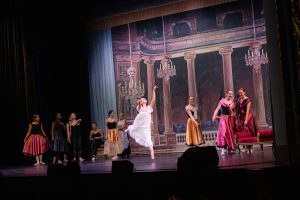
Texas Ballet cast for the Nutcracker rehearses Act I at UT the day before the performance. Saile Aranda/Reporting Texas
“I hope they can feel and see all the hard work put into it,” Maltbie said during rehearsals. “I hope they can see that the dancers really love what they do.”
Passmore said she enjoys performing “The Nutcracker” because it represents an intersection of the ballet world and general pop culture. Since most people are familiar with the ballet, she hopes the club reaches a broader audience.
“The Nutcracker” tells the story of a girl named Clara whose parents throw a Christmas party where her uncle gives her a toy-soldier nutcracker. The doll later comes to life in her dreams to fight human-sized rats, she then travels to the land of sweets with her Nutcracker prince where the Sugar Plum Fairy welcomes them with a series of international dances.
The recital dates from Russia in 1892, and it is still performed annually around the world during the holiday season.
Caroline Clark, who teaches ballet history at Austin Community College, said “The Nutcracker” plays an important role in keeping ballet organizations viable.
“Nowadays, cities across the U.S. rely on that income from ‘The Nutcracker’ to support their entire year,” Clark said “If they didn’t do it, they would have to fold.”
Clark said the phenomenon of the holiday recital boomed in 1954 when choreographer George Balanchine, who fled the Russian Revolution, proposed the idea to perform The Nutcracker in New York. Americans were not familiar with the ballet performance but they were familiar with the orchestral music, which was featured in Walt Disney movie Fantasia (1940). She said this helped The Nutcracker become a success in the United States.
“‘The Nutcracker’ is such a cultural touchstone for ballet in the United States in a way that it is not around the world,” Clark said.
Both Clark and Passmore rebutted Oscar-nominated actor Timothée Chalamet’s widely criticized statement in February that “no one cares” about ballet and opera and that those art forms are not part of mainstream culture anymore.
Clark said that although ballet has a history going back more than 500 years, ballet is a cultural living practice that people still enjoy by taking classes and performing.
“Ballet,” Pasmore said, “is a form of art that tells stories — and remains incredibly relevant.”