Austin’s Own ‘Field of Dreams’ Celebrates Community Over Competitiveness on the Sandlot
By Jackson Bauer
Photography By Jackson Bauer
Reporting Texas
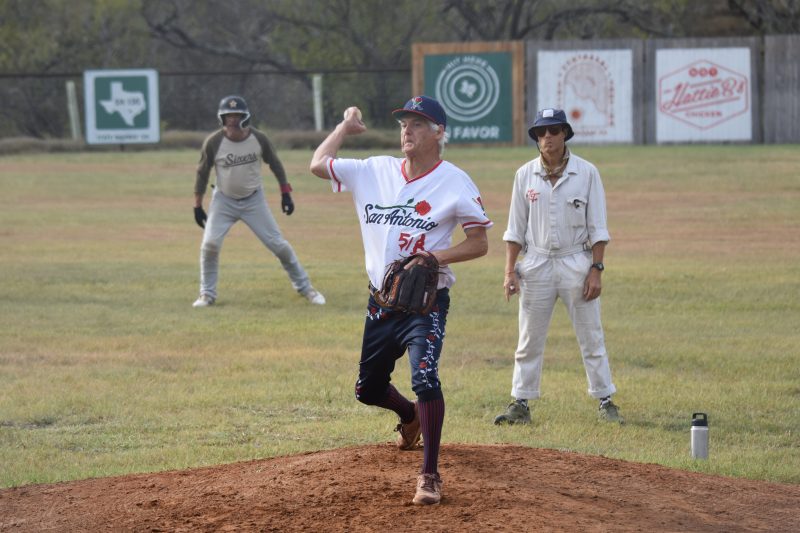
John Hughes delivers a pitch for the San Antonio Roses Sunday at the Long Time’s Wishing Well Field in Lockhart, Texas. Jackson Bauer/Reporting Texas
The crack of a wood bat is drowned out by chatter, laughter and live music at a small field 12 miles east of Austin where baseball is secondary to community.
“For me, it’s about creating an inclusive environment and something that feels really homegrown or authentic,” said Matt Orr, 39, who manages events at the Long Time, a baseball-themed event space.
Over the weekend, as the Brewers and Rays began the major-league World Series, the Long Time hosted its own Fall Classic. Seventeen teams from as far as San Francisco and Minneapolis played in the “Sandlot World Series,” a three-day event of baseball, good vibes and fun.
Sandlot baseball is played on makeshift fields and is often unstructured with few rules. In fact, at the Long Time there are only two — “wood bats only and don’t be a dick.”
Jack Sanders, 50, was doing research for his architecture thesis when he was introduced to the sandlot baseball scene in Newbern, Alabama, a town of fewer than 200 people, more than 20 years ago. He moved to Austin shortly after and talked to friends about creating something similar. In 2006, they established their own team.
“We started a team called the Texas Playboys, 25 of us, got Southwest tickets and flew
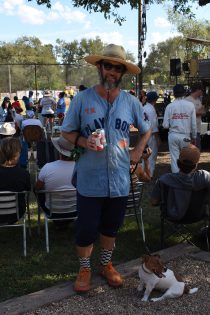
Jack Sanders poses with his dog, Ebby, in front of a packed Long Time. Jackson Bauer/Reporting Texas
to Birmingham, rented cars and drove down and got the crap beat out of us,” Sanders said.
Even though they lost by a significant margin, the Playboys continued to travel and grow as a team. They are celebrating their 20th season this year.
Founded by Sanders in 2017, the Long Time emphasizes community fun and leaves competitiveness at the gate. This weekend it hosted one of its largest crowds yet.
“It celebrates independent programming, you know, that we can make our own fun,” Sanders said. “It doesn’t have to be packaged to you from a corporate entity.”
Most baseball players never play competitively after high school. Now, there are more than 30 sandlot teams in the Austin area and over 100 across the country where people can play the game they love.
Social media has helped foster a connection and relationship between those teams.
“It’s the internet, Instagram and social media that’s connected a lot of different groups that were playing a similar type of baseball,” Sanders said.
You can see that inclusive environment Orr mentioned on the field. Every team has a diverse background, age ranges from 20s to 60s, and skill levels from beginner to expert.
John Hughes, 64, is a member of the San Antonio Roses. He pitched for the Roses back-to-back days Saturday and Sunday.
“I threw 20-30 pitches yesterday, and I probably threw 65 more today,” Hughes said. “The best part is, I won’t be sore tomorrow; my arm never is. If I am, it’s my legs from running.”
Hughes said he loves playing sandlot in San Antonio because anyone can just show up and play.
“You don’t even have to tell anyone you’re going. You can just show up and you’ll get picked up by a team,” Hughes said.
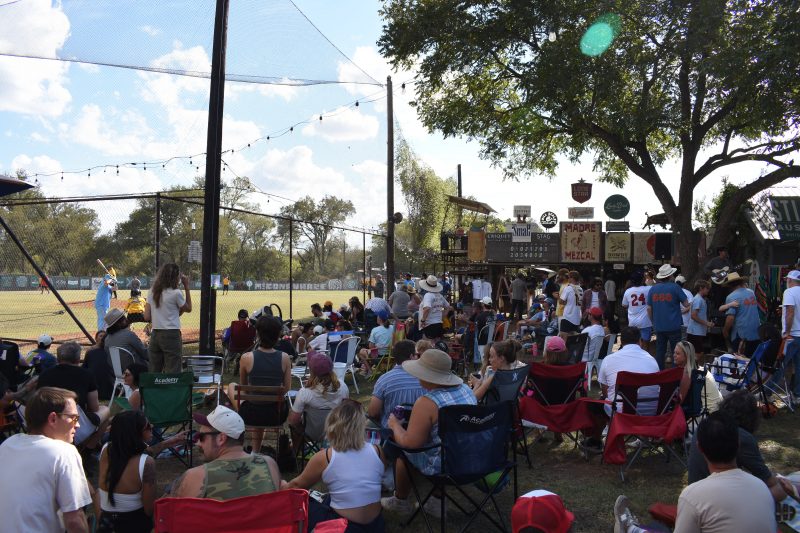
Hundreds gathered to watch baseball, listen to live music and enjoy each other’s company at the Long Time east of Austin on Saturday./ Jackson Bauer/Reporting Texas
The inclusivity of sandlot baseball hasn’t just changed lives; it’s saved them.
Howard Carey, 53, is the founder of Sandlot Revolution, a company that adds some centralization to the sandlot scene. Its goal is to connect teams from around the globe and encourage participation with an emphasis on the sixth tool of baseball — the fun.
Carey stopped playing after high school and didn’t start again until he was 38. Now, has helped dozens who felt excluded from the game growing up to find or rediscover joy playing baseball.
“I’ve had at least half a dozen people tell me sandlot saved their life – that’s what its fucking about,” Carey said with tears in his eyes.
The Long Time also wants to have an impact on sustainability. It partners with Waste Disruptors, and receptacles around the space are labeled “landfill,” “recycle” and “compost.”
“I’ve been saying this for years, that we’re the only zero waste event venue in Austin, and I’m pretty sure that’s true,” Orr said. “There are some other venues that are doing really good environmental work and reducing waste, but when I say we’re zero waste, I mean … we’re literally weighing each piece of trash.”
A sustainability tab on the Long Time’s website tracks its waste management. In 2025, nearly 90% of its waste was diverted from the landfill.
Chris Knoester, the principal investigator of the National Sports and Society Survey, said they have found adults most commonly cite “not having fun” as a reason they dropped out of youth sports growing up.
“There has been a long-running shift in youth playing more formal, organized youth sport versus playing informal, player-initiated sports activities. Thus, it seems that many people might enjoy a shift towards more inclusive, pleasant, and fun-oriented sports activities – at many stages in the life course,” Knoester said.
Carey recalled a six-year-old at the Long Time telling his father “I didn’t know adults could have fun like this.”
“We gotta do better,” Carey said. “Yes, you’re right. We don’t have fun, and we need to show you can.”