Uncovering the Buried History of Hardcore Music in the Coastal Bend
By Evelyn Martinez
Reporting Texas
In the South Texas beachtown of Corpus Christi, Texas, known as Selena’s birthplace and home of the iconic Johnny Canales Show where she had her big break, Tejano reigns supreme. The Spanish-language genre continues to pump life through the veins of the city, but for those of more hardcore proclivities, Corpus’ heartbeat always carried the tune of hard rock.
Baptized into the culture of live music through the tall tales of his family’s frequent trips to concerts all over the U.S., Sergio Elizondo grew up with rock and roll coursing through his veins. Living in a town of a couple thousand on the outskirts of the cultural hub of Corpus, his rockero tíos made countless weekend trips into the city to catch local and touring bands alike. As stories continued to pile on over the years, Sergio became steadily frustrated with his youth barring him from joining in on history in the making.
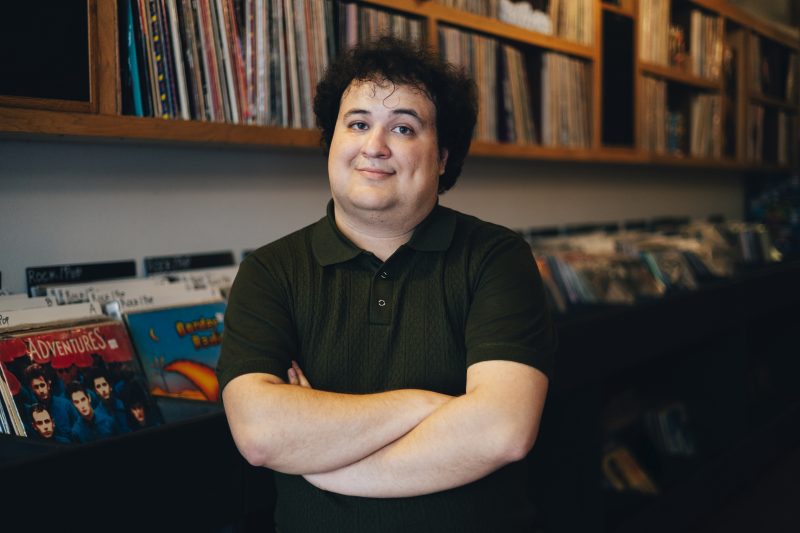
Sergio Elizondo stands inside Hybrid Records in downtown Corpus Christi. Through his CCRiffs project, he collects physical media and firsthand accounts from musicians and fans to help preserve the region’s hardcore music history. (Photo credit: Laro Pilartes)
Once he reached the coveted age of 18, Sergio went to finally explore the Corpus music scene, but found himself in a ghost town. Half the venues he grew up hearing about no longer existed, and in his surface-level research, he constantly came up short. No videos, no pictures, no setlists or mention of the bands that graced the now demolished stages.
Someone had to start the archive, and who better than the one whose bedtime stories consisted of rock shows and bloody noses?
“My mom lived only about 40 minutes from the Corpus music festival grounds, Johnnyland,” says Carlos Elizondo, one of three uncles Sergio grew up with. “My older brother was really passionate about introducing us to this culture of hardcore music before he passed. Going to shows and moshing makes me think of my family. That’s why (me and my brothers) introduced it to Sergio and took him to his first concert in Corpus. Now he’s taking that passion to another level.”
With the help of donations in the form of posters and stories from old and new friends alike, Sergio struck documentarian gold. Beneath layers of new asphalt roads and kitschy TexMex tourist traps lay an erased history of hardcore music in the form of show flyers, VHS recordings and fan-made zines. By digitizing the files he receives and housing them on social media sites like Instagram, he slowly weaves together a more complete fabric of Corpus’ vibrant hardcore culture.
Almost overnight, Sergio became an amateur historian.
“I heard stories of the Corpus scene my whole life from my uncles, but I never had any evidence,” Sergio says. “I knew about bands that had played here before they got famous, but I didn’t realize how vast and crazy (the local scene) really was until I started doing research.”
Now a year and a half into his journey, Sergio turned what began as a weekend hobby into a full-blown historical archive. Perched on the bar bench inside his current home base, the city’s inimitable House of Rock, Sergio summarizes the decades-long history uncovered so far through the retelling of what have now become familiar stories. With a beaten-up cardboard box under his arm and a black duffel bag slung over his shoulder, his hard work lives in the trunk of his navy blue car, readily accessible to those who dare ask about his dearest hobby.
He fiddles with the hundred or so files in their brown flimsy carrier and comes up with the first of many brittle paper posters. He removes a bright yellow flyer from its transparent sleeve, bearing the names of famed Corpus bands Angkor Watt and Sweet Daddy, and casually name drops the booker, the venue and the date in month-day-year format.
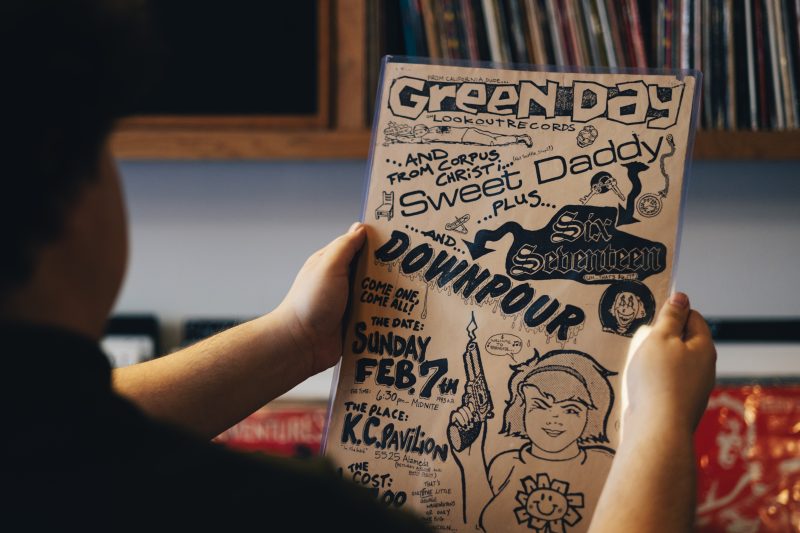
Elizondo holds up one of many preserved concert flyers in his collection. Through his research, Elizondo has archived everything from VHS and tape recordings to handmade posters and ticket stubs.(Photo credit: Laro Pilartes)
“This one is just beautiful,” he says of the slightly decayed flyer decorated with the hand-drawn portrait of a cartoon man pulling his own teeth out. “I love how disgusting it is.”
Inspiration first struck him on a high school trip to New York. A shy kid looking to pursue theater arts, the trip took him out of the comfort of Alice, Texas and threw him into the bustling world of the Big Apple. His visit to the Museum of Modern Art coincided with the debut of an exhibit on famed NYC music club CBGB, which saw the likes of the Ramones and Patti Smith in its 30 odd years of existence. The exhibit displayed old bricks salvaged from the wreckage of the venue, along with posters, flyers and plaques containing show stories that made the club the icon it remains to this day.
Seven years later, in October of 2023, Sergio finally embarked on the journey of a South Texan version of what he saw that morning in NYC. He went on to call his own edition of the MoMA exhibit, “Corpus Christi Riffs: A history of the scene.”
“I’ve been showing Sergio what I’ve collected over the years,” Carlos notes. “My old band T-shirts, a piece of the wall from Woodstock ‘99. He’s always been passionate about concerts, but I really think showing him these things (throughout his life) created all these emotions in him that have helped him (with this project).”
Although the idea simmered on the backburner for years, Sergio’s fascination with the stories of Corpus’ old festival grounds, Johnnyland, served as the final push to get him started. The rotating punk and hardcore bands that made a home of the short-lived stage raised questions for Sergio. He hoped to find answers to them in the beaten up cardboard boxes lying forgotten in the garages of local rockers.
“I helped people organize their posters and talked to them hoping they had stories about Johnnyland,” he explains. “That was always my end goal, and it worked, but I’ve found way more (material) than I ever imagined.”
He dives deep, gushing not only over the posters and poster-making process, but over everything: the music, the members, the audiences, the zine makers, even down to the band names. For the four hours we sit at the bar, we have little to no moments of silence.
Almost sensing the energy shift in the building, Casey Lain, owner and main booker for the venue, saunters in from his back office. Wearing a hat, sunglasses and a delicately trimmed graying beard, he comes up to the table as if anticipating Sergio’s arrival all afternoon.
“Hey Sergio! Who’ve you got to show off your stuff to this time?”
Much like Sergio, Casey was born and raised on the outskirts of Corpus’ borders, but considers it to be as much his hometown as the farm range he grew up on. He would make the trip into the city frequently to see his favorite local acts, most of them in the same since-shuttered venues Sergio had only ever had the chance to obsess over. Their mutual love for live music, the mummification of culture through physical media and the overwhelming talent found along the city’s coast made the duo’s connection instant.
“He’s hard to shake now that we’ve gotten to know him and his personality,” Casey laughs. “It sounds negative but it’s not at all. Now that he’s comfortable chatting with me, I get a text message from him almost every day.”
“Sometimes I’ll find old flyers and I’ll send it to him to check out, or he’ll send me some things and I’ll tell him how I booked that show,” he continues. “It’s a good back and forth.”
Since their first encounter in 2023, Sergio and Casey have become unofficial partners. Sergio’s exhibitions take place mostly inside the brick walls of the music venue located in the heart of historic downtown. At these exhibits, Sergio displays his myriad of posters and flyers, and even sets up a TV to play restored VHS recordings.
Almost as importantly, he networks.
“It’s like social ping pong sometimes,” Sergio describes. “I always have trouble talking to people, but (the interviews) really test my social skills. I’m more social now than ever. I have to elevator pitch at these loud bars or concerts in order to get these VHS tapes.”
“Sometimes I have to wait 20 minutes before I can ask a question,” he laughs, “but I like letting them talk. That’s how I get good sources.”
Sourcing, however, is only half the work. The fluidity of the conversation itself determines its value, and Sergio knows this to be his toughest job. People have already attempted to tap into this history before, most notably with a full-length documentary titled “Subcultured: The Rise of DIY Rock in Corpus Christi,” and failed to garner the necessary interest needed to truly get the full picture.
As I watched the way each employee and patron who wandered into the bar throughout the evening regarded him like a close personal friend, it became clear why the CCRiffs project has stuck with people more than a professionally recorded documentary ever did.
They didn’t have Sergio back then.
“Once someone sees that fire and passion in Sergio, they just want to fuel it,” Carlos describes. “You just want to throw more gas on that fire. You never know what could come out of it.”
It’s easy to trust him with these pieces of paper gold, Casey explains, when he approaches everyone, from lead singers to zine makers, with a burning desire to learn more. Those who have gotten to know him in this process consider his clear, unrelenting love for the history of his pseudo-hometown to define the project just as much as the artifacts do.
“The study of dramaturgy I did in college taught me to appreciate learning the facts and motivations of characters,” Sergio explains. “We’re all just characters in each other’s narratives, we all have faults and strengths. I took that and applied it to the music scene. (This project) is me telling each story through the people themselves.”
Sergio’s mind works like a Rolodex, with pages color coded and riddled with details. Each flyer and poster he pulls out comes attached with as much information as a single mind can handle. Flipping through each of his archived zines comes with details on each contributor. He lays down these anecdotes as a backdrop for the artistry that blossomed out of each subculture.
Sergio throws it all around as if it were all common knowledge. To him, each nugget of the city’s rock history deserves to be considered common knowledge.
“I’ve found a lot of stuff, but I’m really passionate about finding more,” he explains. “Eventually I would like to take this kind of research elsewhere in Texas, but I think Corpus is a good starting ground. It keeps me inspired.”
Meeting one piece of the puzzle connects him to another two, which connect to a dozen more. He continuously builds up the bigger picture, and the image continuously breaks through its own frame. As a lone, self-taught historian, Sergio fears burnout may be close behind him, but he promises to keep going until his feet give out beneath him.
As long as the fire keeps burning and the music keeps playing out of the bars he calls home, he’ll be around to make sure someone writes it all down – and to take the posters off the walls before the night ends.
“A lot of these musicians didn’t keep their stuff, so another part of my journey is to keep their memory alive,” Sergio explains. “Because without memory, who are we?”