‘House of Cards’: Whisper Valley Residents Want Answers for their Broken Homes
By Max Mazoch
Photography By Max Mazoch
Reporting Texas
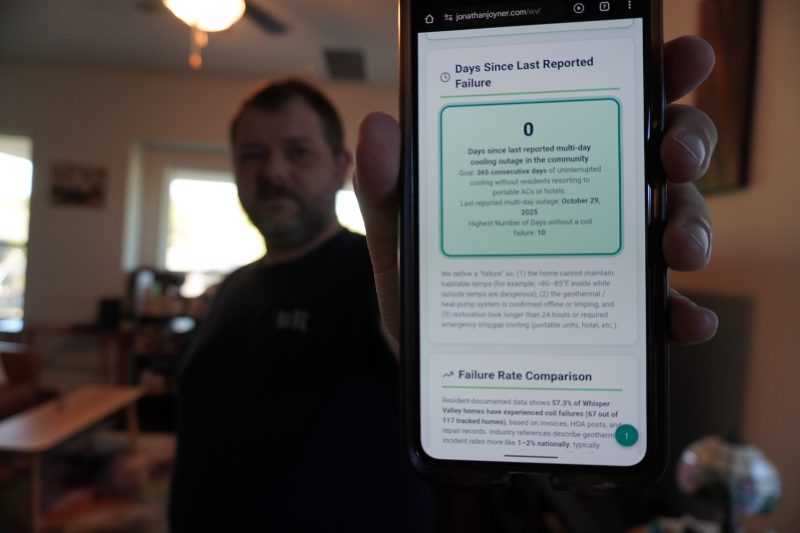
Weston Rodberry shows data from a Whisper Valley resident’s coil failure on Nov. 2. Residents built a website where the community can report and track coil failures in their geothermal HVAC systems. Max Mazoch/Reporting Texas
Michelle MacAlpine knew something was wrong when white steam escaped from her home’s air vents. Before long, her home in Manor lacked air conditioning in the 107-degree August heat.
MacAlpine had no cooling for nine days. During that time, her neighbors banded together, purchasing two air conditioning units and donating every portable fan they could find.
It was noble. It was also the third time.
“Typical Whisper Valley,” MacAlpine said.
MacAlpine has lived in Whisper Valley, Texas’s first geothermal community, for seven years.
Developers marketed the neighborhood, which completed construction of its first homes east of Austin in 2017, as having an affordable cost of living thanks to the solar-paneled roofs and a geothermal system that connects to each home to provide energy-efficient heating and cooling.
But as their homes age, Whisper Valley residents report failing geothermal HVAC systems and foundations that have left them with bills in the thousands of dollars.
“The first couple years it was everything you would want in a place,” McAlpine said, but “once it starts falling apart, you realize it’s a house of cards.”
Representatives of the developers did not respond to requests from Reporting Texas for direct comment.
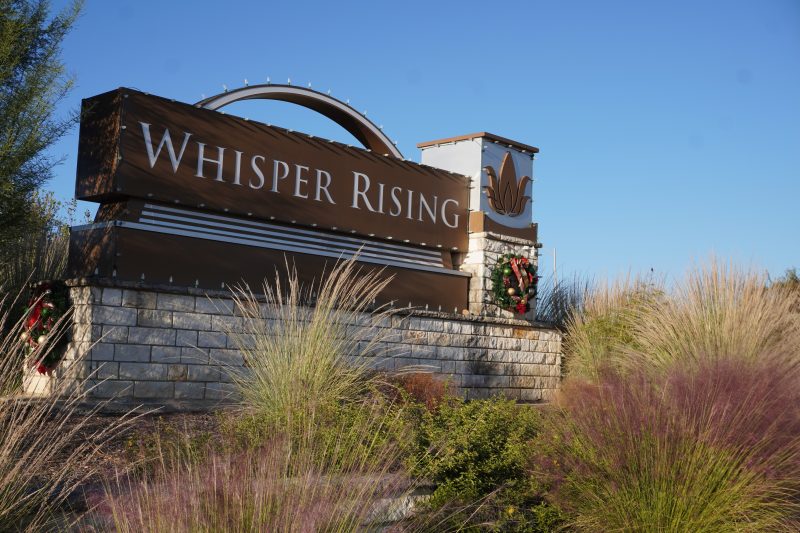
Whisper Rising, the original section of Whisper Valley located in Manor, is the state’s first geothermal community. Homes in the development are connected by an underground geothermal loop that provides heating and cooling. Max Mazoch/Reporting Texas
More heat, more problems
One of the frequent issues Whisper Valley homes face is coil failures associated with the geothermal HVAC system.
In Whisper Valley, each home has a vertical well that connects to a shallow closed-loop geothermal system managed by the private utility company, EcoSmart Solution LLC. Fluid runs through the loop, up through the wells into the homes’ HVAC system, and exchanges heat with the home.
When it fails, residents like MacAlpine must pay $975 to $1,500 and wait up to nine days for a replacement coil to be produced and shipped by Enertech LLC, the HVAC system’s manufacturer.
Residents suggest coils fail because the water entering the HVAC unit from the geothermal system is too hot.
Residents have access to the daily water temperature of the geothermal loop and report it is typically above 85 degrees with the temperature occasionally spiking to over 100 degrees. They believe the high temperatures could be straining the HVAC systems and causing the failures.
The manual for the Enertech HVAC unit says the units can handle water temperatures of 25 to 120 degrees.
On Aug. 3, residents said the water temperature spiked to 112 degrees, and multiple homes experienced system failures.
“The failures tended to be like dominoes on our street,” MacAlpine said “Ours went out; a few weeks later the neighbors would go out.”
A recent investigation by an outside engineering firm suggested there is no design or operational issue with the geothermal system causing the coils to fail. That suggests, according to the report, that the cause of the failures could be attributed to structural problems with individual homes.
A third-party building science firm is also investigating homes in hopes to find the root of the failures.
Hot regions like Texas experience higher rates of coil failure regardless of whether the HVAC system is geothermal or the more common air cooled, said Jeff Hammond, executive director of the International Ground Source Heat Pump Association. The cooling process builds moisture in the coils, causing them to corrode.
Residents said failures frequently occur in the summer, when the cooling use is heavy, and are less frequent in the winter.
The cause of the repeated coil failures remains unresolved.
Shifting soils
Residents also experience major foundation issues with their homes, particularly in Phase 1 homes, the original section of the development.
Residents said Whisper Valley was built on expansive clay soil with a potential for 14 inches of upward swelling when soaked by water.
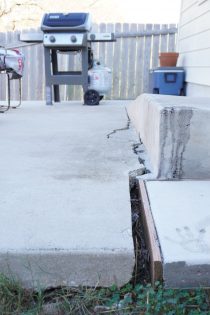
Julie Evins’ back porch cracks from the expansive clay soils below her Whisper Valley home. ‘One day my husband and I are going to wake up; and we’ll be sliding down our backyard,’ Evins said.
Weston Rodberry, a sustainable architect living in Phase 1, said the preventative measures developer Taurus LLC took while building the homes were not enough to stop homes from suffering structural damage.
“It’s not that the houses weren’t built to a high code.” Rodberry said. “They just weren’t built for this kind of soil.”
MacAlpine’s home was built with foundation piers, one of the ways Taurus LLC tried to prevent structural damage. These piers are designed to support a home’s foundation by shifting the weight from the unstable soil to the piers.
MacAlpine paid $108,645.09 on home repairs in 2025, mostly for foundation-related problems including cracked pipes that flooded her home when the foundation shifted.
MacAlpine installed new, more secure piers that extended deeper than the original.
“We were sold this story, but nobody told us we were building on clay and our houses would be in shambles,” MacAlpine said.
Problems without answers
Residents seeking answers said the lack of transparency and responsiveness by Taurus LLC and EcoSmart Solution LLC has made it difficult to find relief.
“We can’t get an answer unless we picket, complain or threaten legal action,” MacAlpine said.
Whisper Valley residents met with members of the development team Sept. 10, including developer Doug Gilliland and EcoSmart Solution LLC CEO Chris Gray.
The developers asked the community to write and submit their concerns to be answered during the meeting — but residents left with more questions.
“It wasn’t a town hall meeting; it was a lecture,” resident Jonathan Marsh said. “It felt like they were talking down to us.”
“It was the same talk we are given when you buy a home in the neighborhood,” Rodberry said.
The developers suggested creating a focus group to appease the angry residents. After the meeting, Marsh and other residents created the group to organize their concerns and work with Taurus LLC and EcoSmart Solution LLC to resolve the issues.
But Marsh said David Currie of Taurus LLC called to ask if he would join a separate focus group of residents chosen by the developers.
Marsh said he attended meetings with the developers’ focus group until each resident member was sent a code of conduct with strict guidelines that said members “must not air grievances” and “must assume the developer and experts act in good faith.” A resident member would receive a warning on the first offense of the guidelines and receive a year suspension from the focus group after a second offense.
Marsh left the focus group shortly after receiving the rules.
“I don’t know how anybody would agree to that,” Marsh said.
Gilliland and Gray did not respond to requests for an interview with Reporting Texas.
There is little opportunity for homeowner representation outside of the focus group, residents said.
Whisper Valley is a City of Austin public improvement district , an area the city has decided is key for economic development. Austin issued multiple revenue bonds to pay for city services, like building roads, for the development: including a $4,500,000 bond for Phase 1 and a $6,820,000 bond for Phase 2.
The residents pay for the bond through fees based on their property’s size, worth between $13,344.13 to $32,289.19, paid either upfront or through yearly payments.
Whisper Valley residents agreed to a restrictive covenant when they purchased their homes limiting homeowner representation until 2065.
“We have no power. The only power that we have is our voice,” MacAlpine said.

Will Singer manages the Apollo Garden in Whisper Valley, one of several organic gardens that residents cite as a benefit to living in the environmentally friendly community east of Austin. Max Mazoch/Reporting Texas
‘The Kind of Neighborhood Everyone Wants to Live In’
Whisper Valley’s sprawling green spaces, tight-knit community and environmentally friendly ethos have appeal to residents and potential buyers.
Once complete, Whisper Valley will have 5,000 single-family homes and 2,500 multi-family units, including 48 Habitat for Humanity homes that began construction in October.
“If we could just get the developer to fix these problems, this would be the most wonderful community in the world,” MacAlpine said.
But residents say they feel stuck.
For sale signs dot the front yards of homes throughout Whisper Valley. The residents pointed out one home that’s been vacant for nearly two years.
Residents report those who have moved have sold their homes for nearly $100,000 under the purchased price.
“We walked into a fly trap,” MacAlpine said.
Rodberry replied warmly, “best group of flies to be stuck with.”